

How to use this guide
This guide concerns embryos that have already been cryopreserved and need to move between fertility clinics, cities or countries. Transport is not the same as embryo transfer, and it does not cover the long-distance movement of fresh embryos. Aviation, import, consent and clinic-licensing requirements can change. Before any booking, the sending laboratory, receiving laboratory and specialist courier should confirm the proposed route in writing.
Most clinical studies of embryo transport are retrospective and cover selected routes, devices and laboratory networks. They show that well-controlled transport can achieve good outcomes; they do not prove that every route is risk-free. Regulatory documents describe process requirements but do not replace case-specific written approval.
1. Start with the decision, not the shipment
Frozen embryos can be transported between institutions and across borders. A professional process is designed to keep them continuously within a validated ultra-low-temperature environment while preserving identification, documentation and chain of custody. Routine transport does not require the embryos to be warmed.
The practical question is whether transport solves a material problem. It may be valuable when a family has moved, the original clinic has stopped operating, an existing embryo cohort cannot readily be replaced, or the embryos must reach the clinic that will perform treatment. If the original clinic can provide the same treatment and a move offers only minor convenience, the extra cost and procedural risk may not be justified.
Transport risk should be separated into distinct layers: cryogenic performance, identity and inventory, compatibility between laboratories, legal and import documents, courier handovers, liability, insurance, destination refusal and any additional warming, biopsy or re-vitrification. The statement “transport lowers success rates” is too broad to support a decision.
Obtain the receiving laboratory's written pre-acceptance before booking; assess transport separately from any additional warming or re-vitrification; do not use a country's reputation as a substitute for laboratory-level evidence; and pause the shipment if any mandatory gate remains unresolved.
2. What frozen-embryo transport actually involves
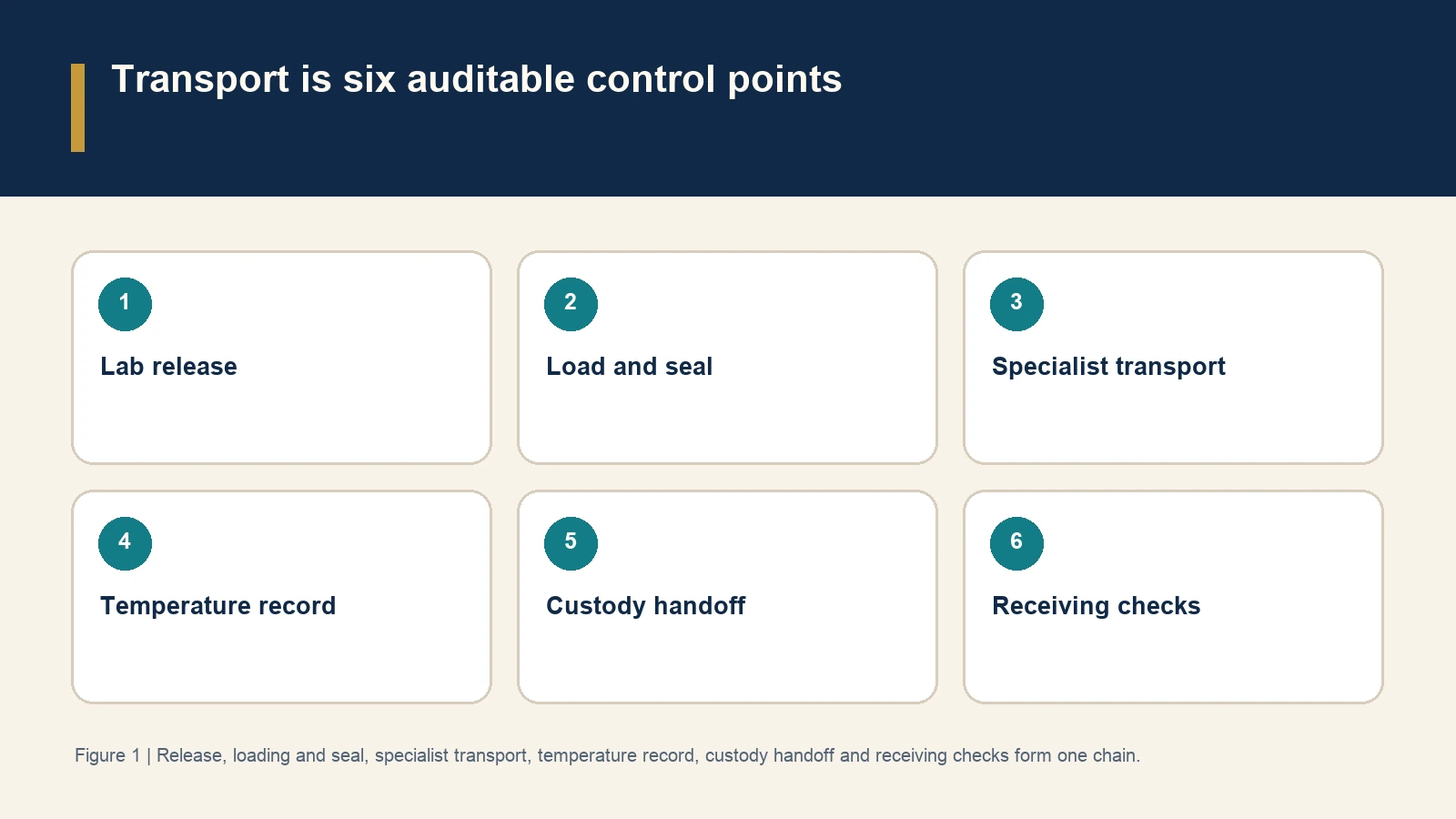
2.1 An ultra-low-temperature system with an auditable custody record
The term “cold chain” can be misleading because this is not ordinary refrigerated or dry-ice shipping. Vitrified embryos are normally carried in a validated dry-vapour liquid-nitrogen shipper. ASRM laboratory guidance states that cryopreserved embryos, oocytes and sperm should be transported in dry shippers that maintain an environment below -150°C, with written shipping and receiving procedures.[1]
A credible plan identifies the shipper model and serial number, validation date, expected hold time, delay margin, temperature-logging method, tamper-evident seal, route, tracking method, named handover points and emergency contacts. An intact-looking container alone does not prove that the temperature remained within specification.
2.2 Arrival checks do not prove embryo viability
The receiving laboratory normally verifies the shipper, seal, temperature record, inventory, carrier identifiers and accompanying records before moving the samples into its own storage system. It cannot inspect cell survival without warming the embryo. Arrival acceptance therefore confirms the condition of the shipment and the consistency of the records; it is not an advance viability test.
If the receiving clinic proposes warming, biopsy, PGT and re-vitrification after arrival, the treatment pathway has gained a separate laboratory intervention. The potential effects of warming, biopsy, re-vitrification and a later second warming must be assessed independently from the transport itself.
2.3 Stage, carrier and protocol compatibility matter
Transported material may be at the pronuclear, cleavage or blastocyst stage. Clinics may use different vitrification carriers, media and warming protocols. The receiving embryologist should confirm familiarity with the original carrier, access to a compatible warming protocol and reagents, acceptance of the open or closed system used, and the ability to interpret the original grading, biopsy and genetic-testing records. A new building or a famous clinic is not evidence of this compatibility.
3. What transport can achieve
Transport may avoid another ovarian-stimulation and egg-retrieval cycle for someone with reduced ovarian reserve, increasing age, a difficult previous retrieval or no realistic opportunity to create another cohort. Its value is continuity and access, not an improvement in embryo quality.
It can also align stored embryos with a family's new residence, an intended transfer clinic, a legally reviewed gestational-carrier pathway or a replacement storage facility. In some cases, the receiving laboratory has verifiable experience with a particular carrier or an established external-embryo intake pathway.
Consolidating embryos stored at several clinics may simplify fees, consent renewals, contact updates and long-term disposition planning. It also concentrates storage risk, so the receiving facility's alarms, backup tanks, liquid-nitrogen supply and disaster-transfer plan should be reviewed.
Transport has weak value when the sending clinic can perform the same treatment, the receiving clinic cannot show an additional capability, and the reason is merely that another country or facility “looks more advanced.” Compare the whole treatment pathway rather than a courier quote or a single transfer fee.
4. What the clinical evidence can and cannot show
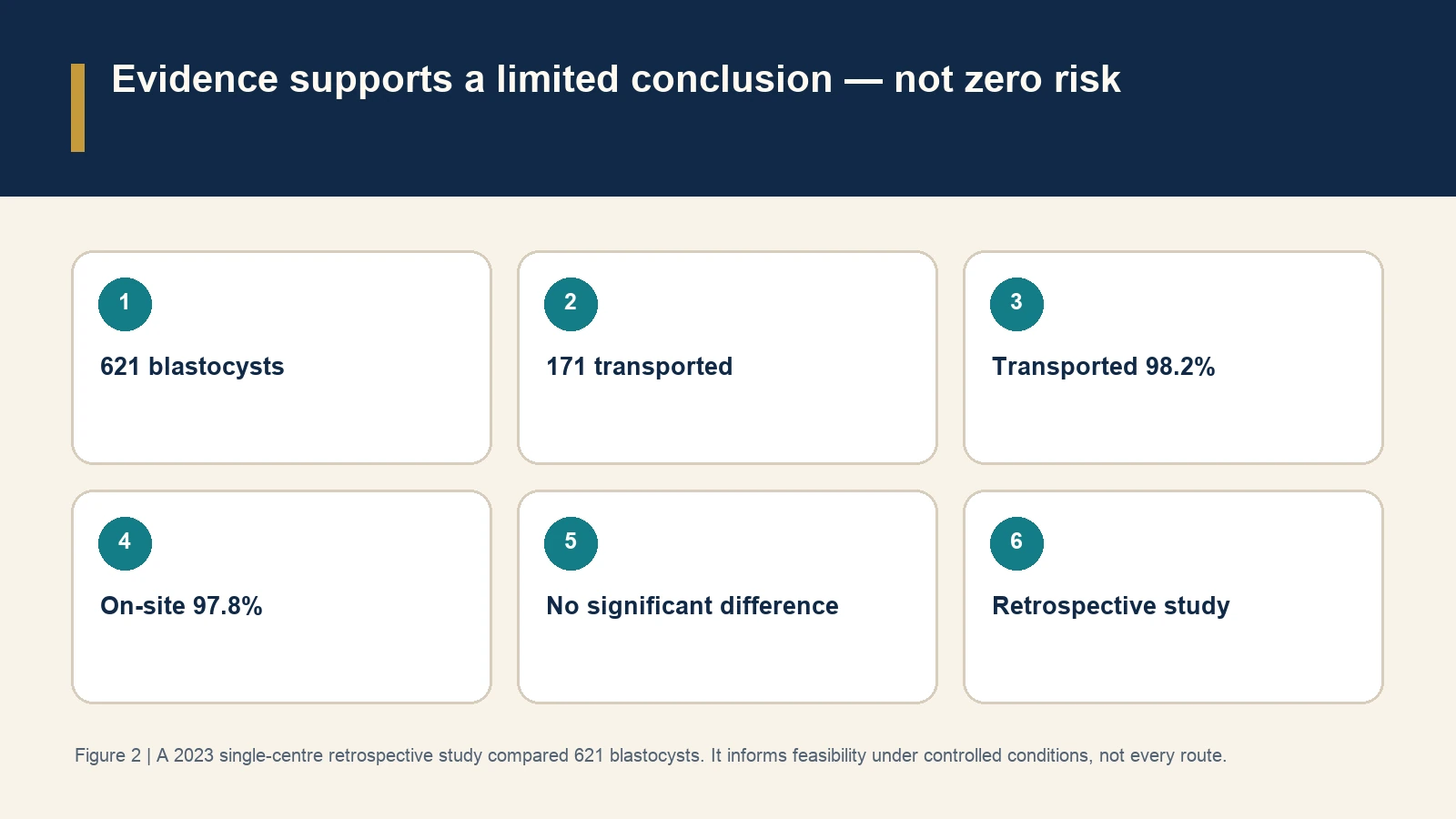
A 2023 retrospective study compared 621 blastocysts warmed at one receiving centre in Rome. Of these, 450 had been created and frozen locally, while 171 came from clinics in Spain. Post-warming survival was 98.2% in the transported group and 97.8% in the local group, with no statistically significant difference; pregnancy, clinical-pregnancy and miscarriage rates also showed no significant difference.[6]
The study supports a limited conclusion: in a controlled network with mature laboratories and a defined process, international transport can preserve a high post-warming survival rate. It does not cover every courier, customs delay, dry shipper or pairing of unfamiliar laboratories, and it cannot support a “zero-risk” claim.
A 2021 prospective device study recorded a maximum temperature of -180.2°C during domestic and international transport and reported no observed adverse effect on post-warming survival or continued in-vitro development.[7] This supports the value of a validated platform and temperature data, but the sample was small and laboratory development is not the same endpoint as live birth.
| Outcome | What it answers | Important limitation |
|---|---|---|
| Post-warming survival | Whether an embryo meets the laboratory's survival definition after warming | Does not by itself predict implantation or live birth; stage and definition must match |
| Clinical pregnancy | Whether the specified ultrasound evidence of pregnancy is present after transfer | Influenced by embryo, endometrium, transfer technique and patient factors |
| Live birth | Whether a cycle or transfer results in a live birth | Requires a stated denominator, age, embryo source, PGT status and transfer strategy |
| Cumulative live birth | The live-birth opportunity from all usable embryos arising from one retrieval | Requires longer follow-up and cannot be compared with a per-transfer rate |
One failed transfer after transport does not establish causation. The age at which the embryo was created, developmental stage, morphology, chromosomal status, warming technique, transfer procedure, endometrial factors and chance all affect outcome. A transport investigation needs the shipper record, temperature data, seal and custody records, and the receiving laboratory's warming report.
5. Review risk layer by layer
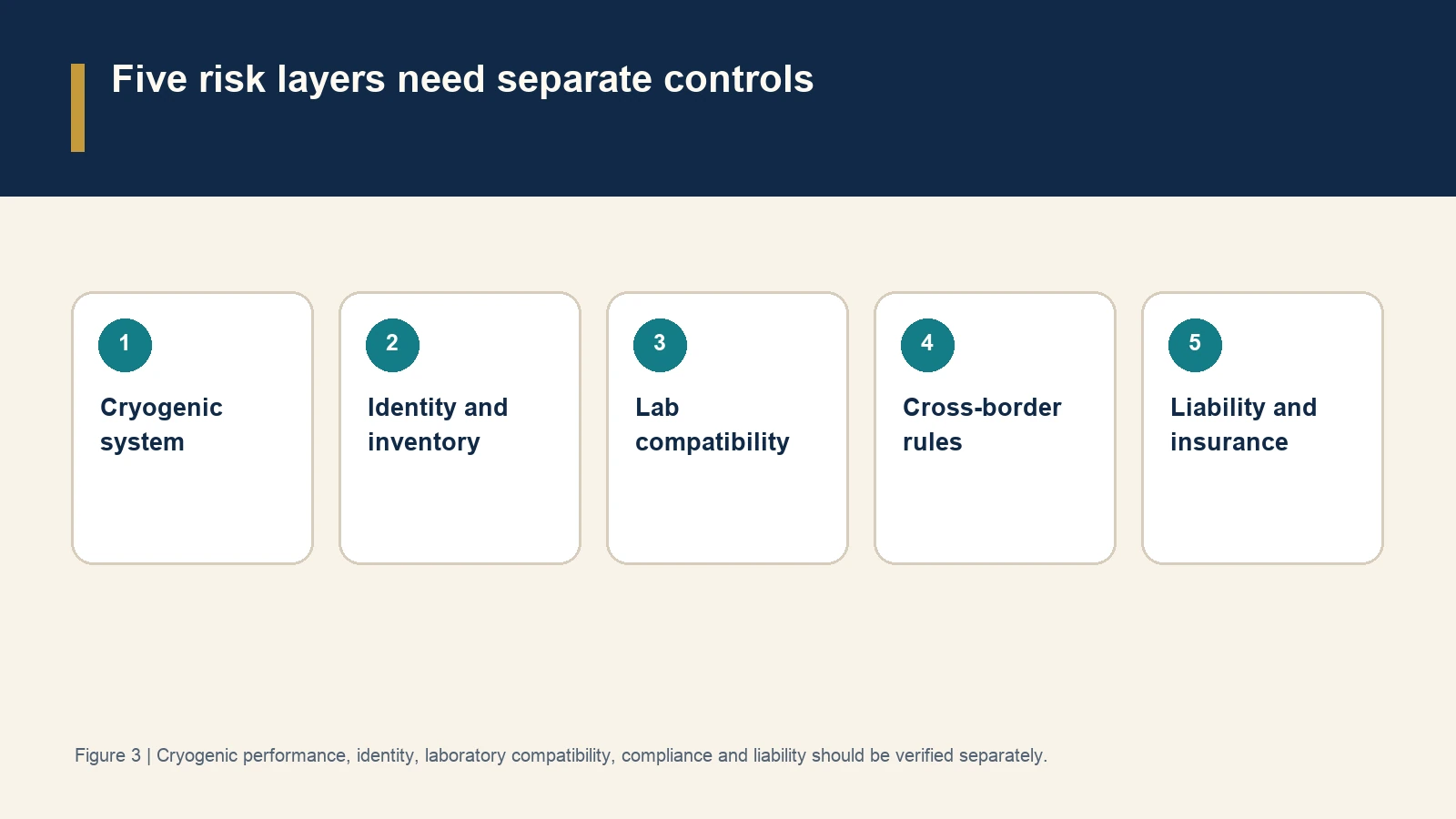
| Risk layer | What can go wrong | Evidence to obtain before release | Red flag |
|---|---|---|---|
| Cryogenic system | Insufficient hold time, route delay, damage or missing temperature data | Shipper validation, preparation record, hold time, delay margin and logger plan | Only a generic promise of “professional cold chain” |
| Identity and inventory | Mismatched identifiers, missing carrier or unclear handover | Itemised inventory, dual witness, seal and signed custody times | Embryo count or carrier ID does not reconcile |
| Laboratory compatibility | Receiving team cannot use the carrier or warming protocol | Written embryology review, carrier and reagent confirmation, external-embryo SOP | “Ship first and we will review it later” |
| Compliance | Consent, donor or import documentation is incomplete | Current licence, consent, ownership, donor and import review | Reliance on an intermediary's oral assurance |
| Liability and cost | Narrow compensation, refusal fees or no contingency storage | Liability cap, insurance scope, refusal and delay terms, backup destination | Contract shifts every risk to the patient without explanation |
Physical risks include inadequate shipper preparation, hold time that is too short for the route, cancellations, prolonged customs detention, tipping, impact and a poorly positioned or failed temperature logger. “Hand carry,” “air cargo” and “dedicated courier” describe transport modes; none removes the need for airline acceptance, written clinic approval and an auditable custody record.
Identification is as important as temperature. The inventory should list the unique identifiers, carrier, embryo stage, cryopreservation date, biopsy status and storage location. The responsible person and time should be recorded at release, loading, pickup, airport or ground handover, customs, delivery and storage intake.
The sending laboratory knows how the embryos were created and vitrified; the receiving laboratory is responsible for future warming, culture or transfer. Different naming, grading, carriers, media and protocols can create risk even when the shipment remains cold. Ask the receiving laboratory for recent experience with the same type of carrier, its survival definition, external-embryo case volume, witnessing system and incident-reporting process.
Cross-border cases may be affected by rules on embryos, gametes, donors, marital status, gestational carriers, PGT, storage periods and importer licensing. Legal permission to enter a country does not mean that every clinic can accept the shipment. The UK HFEA, for example, states that imports and exports must be handled through appropriately licensed clinics and that not all clinics offer the service.[9]
Transport does not automatically create another freeze-thaw cycle. Additional exposure arises when an embryo is warmed for biopsy or another procedure, re-vitrified and later warmed again for transfer. A 2026 systematic review of 17 studies and 36,441 single-embryo transfer cycles found very-low-quality evidence associating repeat biopsy and re-vitrification with lower live-birth and clinical-pregnancy odds and a higher pregnancy-loss risk.[8] Selection bias and confounding limit causal interpretation, and a 2024 single-centre study did not find the same differences.[15]
6. A country's health system is not a laboratory quality score
National health-system capacity affects licensing, infrastructure, emergency care, transparency and legal remedies. The performance of an IVF laboratory also depends on its embryologists, quality management, environmental control, maintenance, witnessing, alarms, workload and case mix. These levels are related but not interchangeable.
| Level | What it affects | Evidence to review |
|---|---|---|
| Country and regulator | Licensing, import rules, donor rules, emergency capacity and remedies | Statutes, regulator lists, current import requirements, inspection system |
| Clinic and IVF laboratory | Vitrification, warming, culture, biopsy, witnessing and quality control | Licence, laboratory director, inspection or accreditation, SOPs, KPIs, incident and disaster plans |
| This transport route | Shipper, temperature, handovers, customs, delays and acceptance | Pre-acceptance letter, route plan, validation, logger, seal, custody and insurance records |
The ESHRE/Alpha Vienna consensus proposed key performance indicators for ART laboratories. Its reference values for blastocyst post-warming survival were a competence threshold of at least 90% and a benchmark of at least 99%.[5] These are quality-management references, not promises to an individual patient. Comparisons require the same embryo stage, survival definition, carrier, case selection, period and denominator.
7. International examples show why sequence matters
The Spain-to-Rome study illustrates transport inside a controlled medical network: 171 transported blastocysts achieved 98.2% post-warming survival.[6] It supports feasibility under defined conditions, not unfamiliar routes with incomplete records.
The HFEA approach puts the licensed receiving clinic before the shipment. Its public guidance notes that not every clinic imports or exports embryos and that a pre-existing relationship between clinics may make the review easier.[9] This supports a simple sequence: confirm eligibility and documents first, then organise the shipper and flight.
European rules treat traceability as a safety requirement. Identification, donor information, institution details and long-term records have legal and quality-management functions.[12][13] A larger document pack is useful when every document resolves an ownership, identity, compatibility, use or responsibility question.
Hong Kong's reproductive-technology rules also show why compliance and laboratory quality must be assessed separately. Non-medical sex selection is prohibited, with a limited pathway to avoid specified serious sex-linked genetic disease.[14] That legal boundary says nothing by itself about whether a particular laboratory is technically stronger or weaker.
8. When transport may be reasonable — and when to pause
Transport may be reasonable when the family has moved; the destination clinic will perform the transfer; the sending clinic is closing or no longer offers suitable storage; existing embryos avoid another difficult retrieval; several storage locations need consolidation; or the receiving laboratory has a verifiable capability that will change treatment.
Pause when the receiving embryology team has not reviewed the file, inventory or carrier identifiers do not reconcile, donor or import requirements remain verbal, the courier will not disclose validation and temperature-monitoring details, the destination laboratory is unfamiliar with the carrier, the timetable has no customs margin, or proposed biopsy and re-vitrification have no clear medical purpose.
A small number of embryos does not automatically rule out transport. Sometimes scarcity is precisely why transport is necessary. It does reduce tolerance for error: minimise handovers, avoid unnecessary additional procedures, verify matched laboratory experience and document delay and evidence-preservation plans. A large cohort does not make any single embryo expendable; splitting a shipment may reduce concentration risk but adds cost and handling.
9. Five mandatory gates and the recommended sequence
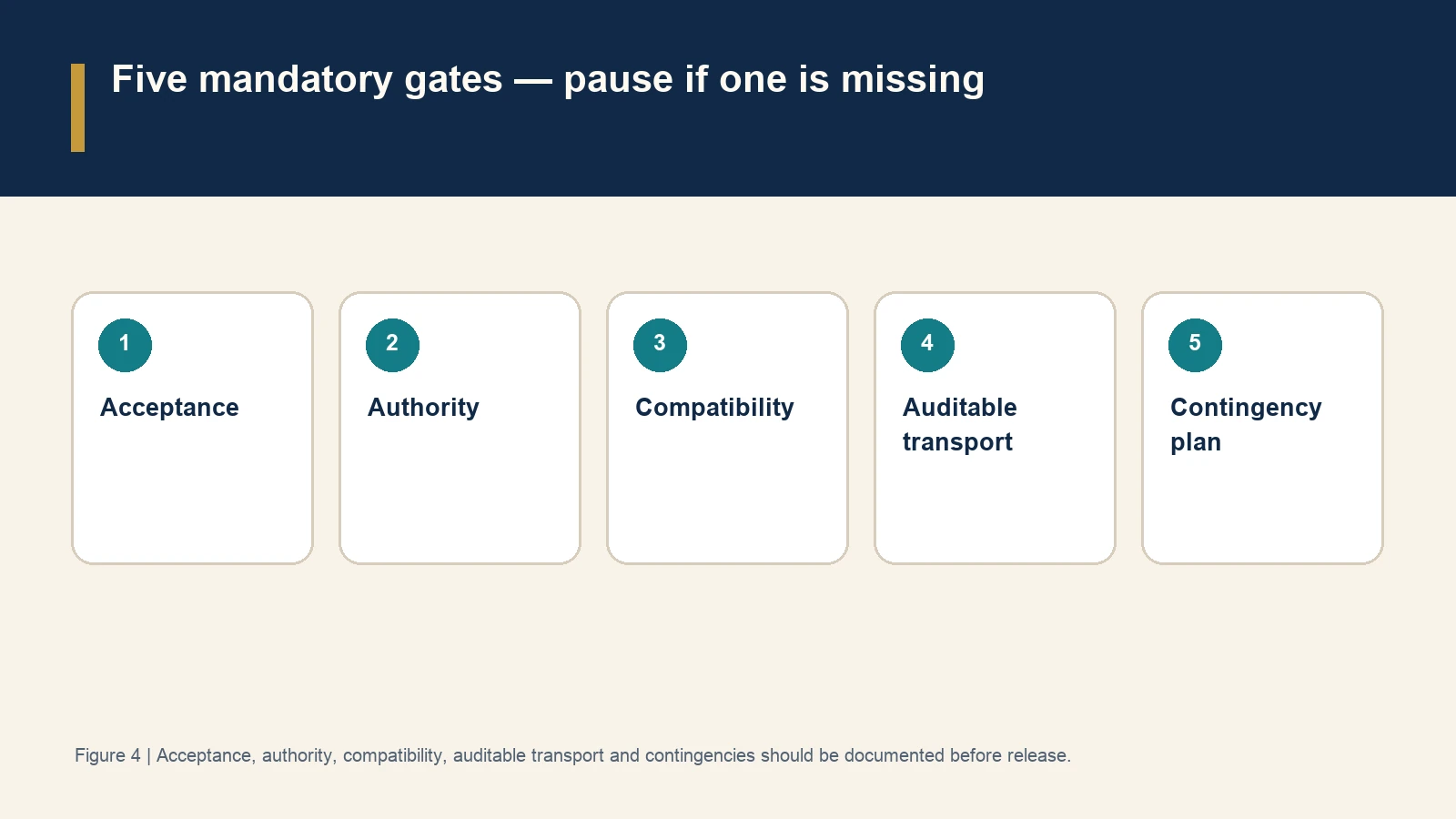
| Gate | Pass standard | If not passed |
|---|---|---|
| Acceptance | Receiving laboratory has reviewed the records and agreed in writing to accept | Do not book; complete review or identify another receiver |
| Compliance | Consent, ownership, donor, import and intended-use requirements have written support | Pause release and obtain formal clarification |
| Compatibility | Carrier, stage, vitrification/warming method and PGT records are usable by the receiver | Arrange an embryology review and identify any extra procedure |
| Transport | Dry shipper, validation, hold-time margin, logger and custody route are specified | Reject a vague “cold-chain” promise |
| Contingency | Delay, refusal, abnormal temperature, backup storage, insurance and responsibility are documented | Complete the contingency plan before fixing a date |
The recommended order is: define the problem that transport solves; obtain written pre-acceptance from the receiving laboratory; reconcile the itemised embryology inventory; complete consent, ownership, donor and cross-border review; approve the dry shipper, logger, route and delay margin; confirm the final manifest and emergency contacts; document loading, seal and release; document arrival, temperature, seal and inventory acceptance; and only then confirm the later warming, PGT or transfer plan.
Booking first and asking the receiving laboratory to review later reverses the risk-control sequence. It creates avoidable pressure if the carrier, records or legal requirements are incompatible.
10. A four-party checklist
| Party | Questions that must be answered |
|---|---|
| Sending laboratory | Exact count and carrier IDs; stage and vitrification date; carrier and system; warming protocol; biopsy/PGT history; any previous warming or re-vitrification; donor records; ownership and consent; witnessed inventory; fees, release timing, loader and emergency contact |
| Receiving laboratory | Written acceptance; rejection criteria; experience with the same carrier and stage; post-warming survival definition and denominator; matched reagents; need for any extra procedure; arrival staff and out-of-hours plan; abnormal-seal or temperature protocol; alarms, backup tanks and disaster plan; fees and responsible clinician |
| Specialist courier | Experience with reproductive material; dry-shipper model, serial and validation; hold time and margin; logger position and data delivery; route and handovers; airline acceptance; customs responsibility; delay route; incident notification; custody, temperature and delivery records; insurance scope and exclusions |
| Legal, contract and finance advisers | Authority to release and dispose; current export, transit and import rules; translation, certification or originals; destination if refused; responsibility for delay or cancelled treatment; evidence preservation; liability boundaries; complete price; cancellation and re-clearance fees; payment tied to release conditions |
The checklist is not a request for marketing reassurance. Each answer should identify a person, document, number, date, definition or contingency.
11. Calculate total cost and the failure plan
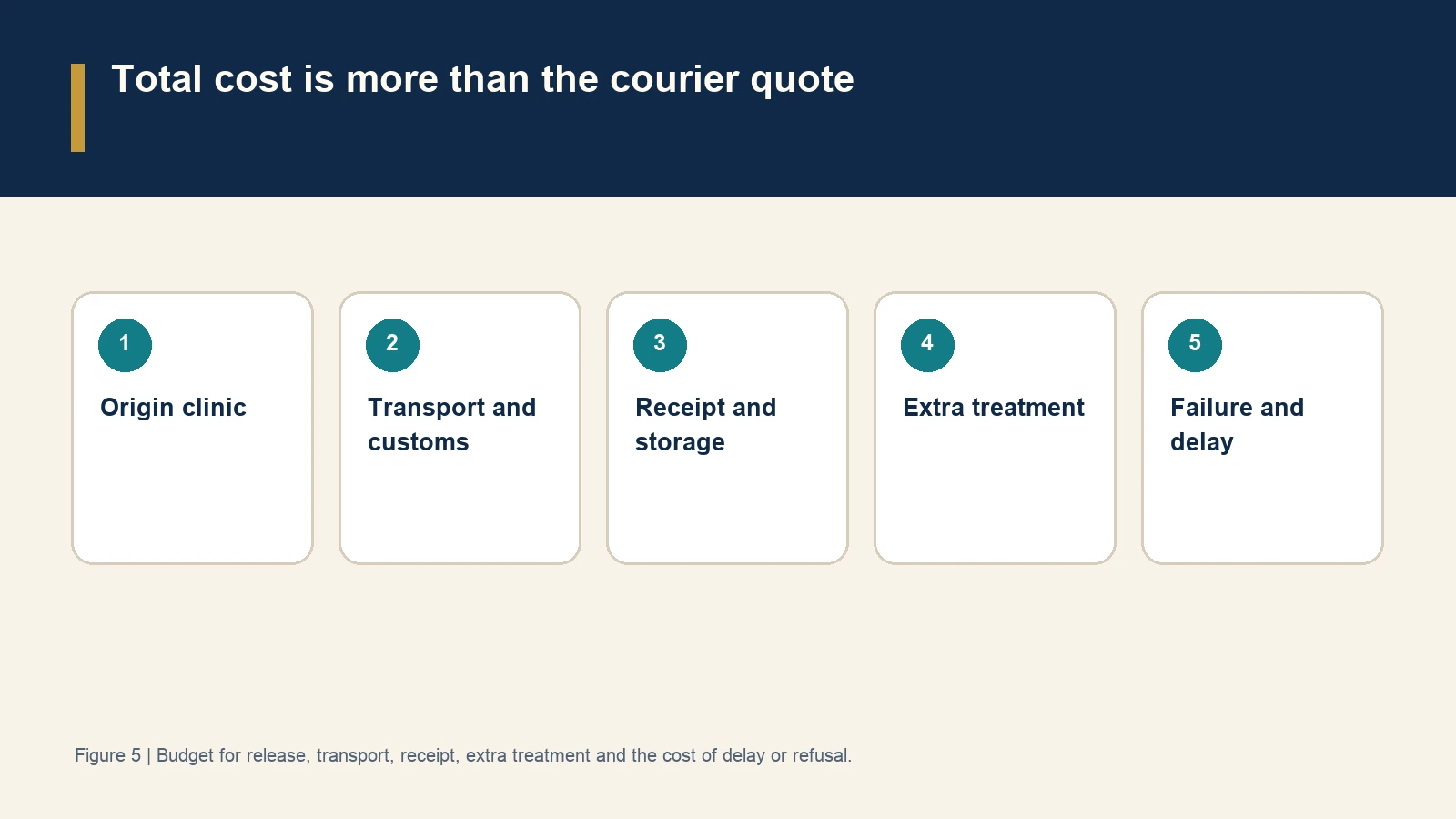
| Cost group | Common items | Pricing question |
|---|---|---|
| Sending clinic | Inventory, records, release, loading and unpaid storage | Per case, carrier or batch? |
| Transport | Dry shipper, collection, air/ground route, logger, customs support and return | Are delays, rerouting and backup transport extra? |
| Destination | Pre-review, intake, storage, translation and required testing | How are refusal, missing records and out-of-hours arrival charged? |
| Additional treatment | Warming, culture, biopsy, PGT, re-vitrification and transfer | Which steps are medically necessary and what alternatives exist? |
| Failure and delay | Cancelled cycle, extra stay, repeated paperwork, return or backup storage | Who pays, what is insured and what is excluded? |
Total transport cost therefore includes sending-clinic release and records, the validated shipper and courier, compliance and customs work, destination intake and storage, any additional laboratory procedure, and the refusal or delay contingency. Compare this with the cost of not moving: another retrieval, continued travel, transfer at the original clinic or a different treatment location.
If an incident occurs, keep the shipper in a qualified low-temperature environment and do not open it in response to anxiety. Notify the receiving laboratory, sending laboratory and courier; preserve seal photographs, original logger files, tracking data and custody records; let the receiving laboratory decide on quarantine or transfer to a backup tank; build a written factual timeline; and avoid warming an embryo merely as a “test” before independent embryology and legal review.
12. Common reasoning errors
Country halo treats a strong national health system as proof of one laboratory's competence. Equipment halo substitutes a new building or imported device for staff, maintenance, SOPs and performance data. Doctor halo ignores the embryology team. Price halo treats higher cost as quality or lower cost as incompetence. None is reliable.
A successful shipment shows that one process worked; one failure demands investigation. Neither predicts the next case by itself. A failed transfer after shipment is not proof of transport damage, and a normal temperature curve is not a guarantee of live birth. Do not confuse post-warming survival, clinical pregnancy, live birth and cumulative live birth.
Legal permission and technical quality are also different questions. A jurisdiction may restrict an activity for legal or ethical reasons without having poor laboratories; permitting an activity does not make it medically appropriate. Finally, do not let sunk costs force release when a mandatory gate has failed. Pausing is a control step, not a permanent refusal.
13. One-page decision rule
| Continue when | Pause when |
|---|---|
| Transport solves a defined problem and alternatives cost more | The reason is only a country or brand preference |
| Receiving laboratory has issued written pre-acceptance | Receiver says “ship first, review later” |
| Inventory, carriers, warming and PGT records reconcile | Count, carrier or biopsy record is incomplete |
| Consent, use and cross-border requirements have written support | Legality depends on chat messages or an intermediary |
| Shipper, logger, hold-time margin and custody are auditable | Courier will not disclose device or data details |
| Refusal, delay, insurance and backup storage are agreed | No named destination or responsible person after a delay |
| Any additional biopsy or re-vitrification has a defined medical benefit | The extra procedure will not change treatment or lacks a clear purpose |
Proceed only when all five mandatory gates have passed. A failed gate means “not yet,” not necessarily “never.” Resolve it and reassess.
14. Practical conclusion
Frozen-embryo transport is manageable medical logistics, but risk cannot be reduced to zero. A validated route, dry-vapour liquid-nitrogen shipper, temperature record, complete identity and custody chain, and an experienced receiving laboratory can control many risks. Available clinical evidence does not show that properly managed transport inevitably reduces post-warming survival or pregnancy outcomes, but the evidence is too limited to guarantee every route.
If the original clinic can provide the same treatment and transport offers little more than convenience, fewer handovers may be preferable. If transport avoids another retrieval, maintains continuity after a move or gets irreplaceable embryos to the clinic that will use them, its value may be high. Additional warming, biopsy or re-vitrification must remain a separate medical decision, not an unexamined part of a transport package.
Country-level reputation is background information. The decision rests on the specific laboratories, people, performance definitions, route, records and responsibilities. Put those items in writing before the embryos move.
Sources and editorial notes
Sources in this panel checked: 7 September 2026
The points checked are listed below. Other data and references retain their own dates and scope.
- HFEA · Importing and exporting sperm, eggs and embryos
HFEA describes UK import/export arrangements through licensed clinics; not every clinic offers the service. Other destinations require separate checks of local rules and both laboratories’ acceptance conditions.
Compiled by FS Global Ferticare Group. Medical explanations draw on the public guidance listed here; individual test results and treatment arrangements should be discussed with the treating clinical team.
Author and responsibilities · Editorial policy and corrections
Take this question to your next appointment
Confirm acceptance before comparing transport quotes.
Ask both clinics for laboratory contacts, required documents and acceptance conditions. Reconcile embryo inventories, consents, reports and missing items before paying a carrier.
Request written transport scope, temperature records, incident notification, insurance and handover evidence. Confirm the transport booking and medical transfer appointment separately.
Document the five gates before the embryos move
FS can help organise the checklist across both laboratories, the specialist courier and the cross-border file. Medical, legal, import and insurance conclusions still require written confirmation from the responsible professionals.
Medical and regulatory sources
These links support the laboratory guidance, clinical evidence and regulatory examples. Import, consent and licensing requirements change; verify the current written position with the authority and receiving clinic before acting.
- ASRM: Comprehensive guidance for embryology laboratories (2022)
- ASRM: Cryostorage of reproductive tissues (2020)
- ESHRE: Good-practice guidance for IVF laboratories
- ESHRE: IVF laboratory guidance on transport and traceability (2015)
- ESHRE/Alpha: Vienna consensus on ART laboratory performance indicators
- Pellegrini et al.: International transport of frozen embryos (2023)
- Logsdon et al.: Vapor-phase shipment and storage evaluation (2021)
- Vireque et al.: Rebiopsy and revitrification systematic review (2026)
- HFEA: Importing and exporting sperm, eggs and embryos
- HFEA: Choose a fertility clinic
- CDC: Interpreting ART success rates
- European Commission: Single European Code for tissues and cells
- EUR-Lex: Directive 2004/23/EC
- Hong Kong CHRT: Code of Practice (2024)
- Al Hashimi et al.: Double vitrification and warming outcomes (2024)
This article provides general medical education and decision-process information. It is not medical, legal, customs or insurance advice and does not guarantee any embryo or pregnancy outcome.