Thailand IVF · Law · Cost
IVF in Thailand: Legal Boundaries, Costs and a Realistic Patient Pathway
Thailand is familiar to many Asian patients, but familiarity is not the same as understanding the legal boundary.
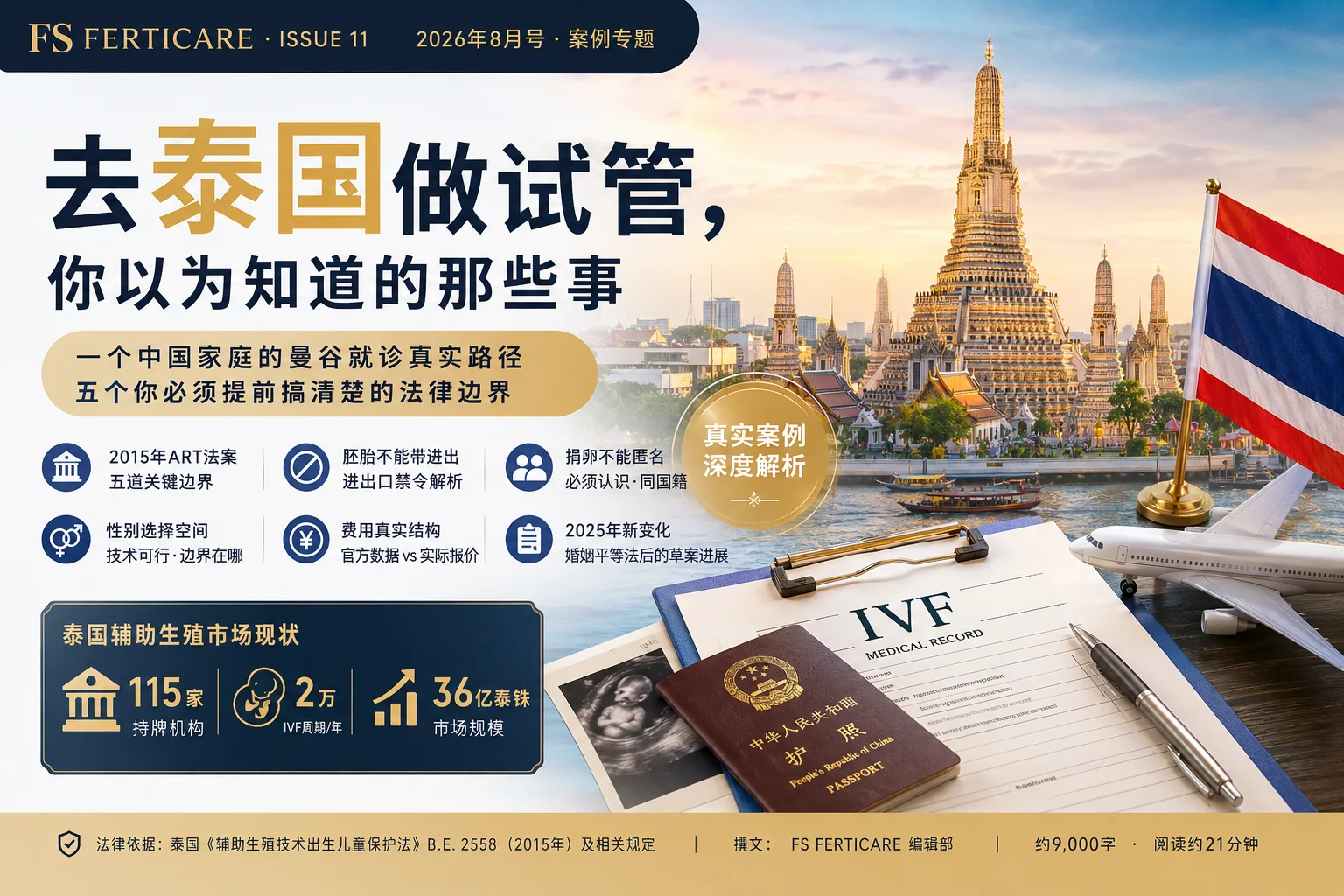
Thailand remains a mature medical-travel destination for IVF. It has experienced clinics, international patient services and relatively convenient travel for many Asian families.
But the 2015 ART law changed Thailand's role. Commercial surrogacy was restricted, foreign-patient boundaries became more important and several services that patients assume are available are in fact legally constrained.
Thailand IVF · Law · Cost
A mature market with legal guardrails
Thailand's strengths are distance, language support, established private clinics and experience with international patients. For a married couple using their own gametes and completing the cycle inside Thailand, the route can be efficient.
The risk begins when patients assume Thailand can also solve donor eggs, imported embryos, surrogacy or non-medical sex selection in the same simple package.
Thailand IVF · Law · Cost
Five legal boundaries foreign patients must know
First, marriage documentation is generally a prerequisite for ART treatment. Second, gamete and embryo import/export is restricted: a frozen embryo created elsewhere cannot simply be imported for transfer, and an embryo created in Thailand cannot simply be exported. Third, egg donation is not a commercial anonymous-bank model; donor eligibility and nationality rules matter. Fourth, PGT reports may contain sex-chromosome information, but clinics vary in how they handle sex-selection requests. Fifth, surrogacy remains prohibited for foreign couples under the current effective framework, despite reform discussions.
| Boundary | Practical effect |
|---|---|
| Marriage proof | Prepare translated/notarized marriage documents before travel. |
| Embryo import/export | Plan to create and transfer embryos within Thailand if using Thailand. |
| Egg donation | Do not assume anonymous commercial donor matching. |
| Sex selection | Clinic policy varies; avoid broker exaggeration. |
| Surrogacy | Foreign surrogacy is not an ordinary Thailand IVF service. |
Thailand IVF · Law · Cost
A realistic patient pathway
A typical overseas couple may travel for initial consultation and testing, start stimulation, retrieve eggs, perform ICSI, culture embryos, consider PGT-A, freeze embryos and return later for FET. The medical path can be smooth when documents are ready and expectations are realistic.
Common surprises include needing marriage documents in English, being unable to bring existing embryos, and discovering that donor eggs require a known eligible donor rather than a clinic-provided anonymous bank.
Thailand IVF · Law · Cost
From public price to real budget
Public IVF or ICSI prices rarely include every line. Medication, anesthesia, ICSI, blastocyst culture, PGT-A, freezing, storage, FET, travel, translation and coordination can double the real budget.
A responsible quote should list cycle fee, medications, laboratory add-ons, PGT-A count, freezing, storage, transfer and travel assumptions separately.
Thailand IVF · Law · Cost
What changed in 2025 and what did not
Thailand's Marriage Equality Act entered into force in 2025, creating a broader legal basis for same-sex spouses in family law. Separate ART law reform proposals have been discussed, including possible changes around surrogacy and terminology.
A draft is not effective law. Until formal enactment, families should plan according to the current effective ART framework and recheck before signing.
Thailand IVF · Law · Cost
Thailand versus Kyrgyzstan
Thailand is best understood as an IVF destination for eligible married patients who can complete treatment within the Thai legal frame. Kyrgyzstan is evaluated differently when the family needs a surrogacy and birth-document chain.
The right question is not which country is better. It is which country fits the actual medical, legal and document needs of the case.
FAQ
Can I bring frozen embryos into Thailand?
Under the current framework, patients should not assume embryo import is permitted. It must be checked as a legal restriction, not a logistics issue.
Can foreign couples use surrogacy in Thailand?
Commercial surrogacy and foreign-couple surrogacy remain restricted under the current effective law.
Did the 2025 marriage equality law automatically change ART access?
No. It changed marriage law, but ART-specific rules need separate effective amendments.
Sources
Review your pathway before you commit
If your case involves IVF, donor materials, surrogacy, documents or cross-border return planning, organize the medical and legal chain before comparing packages.
Request a pathway reviewThis article is for reproductive-health, legal and pathway education only. It is not medical diagnosis, legal advice or a success guarantee. Individual decisions require physician and legal review.