IVF · AI · Assisted Reproduction
From the First IVF Baby to AI-Assisted Creation of Life
A human-centered account of how assisted reproduction moved from the first IVF birth to AI-supported embryo selection and automated laboratory workflows.
Opening
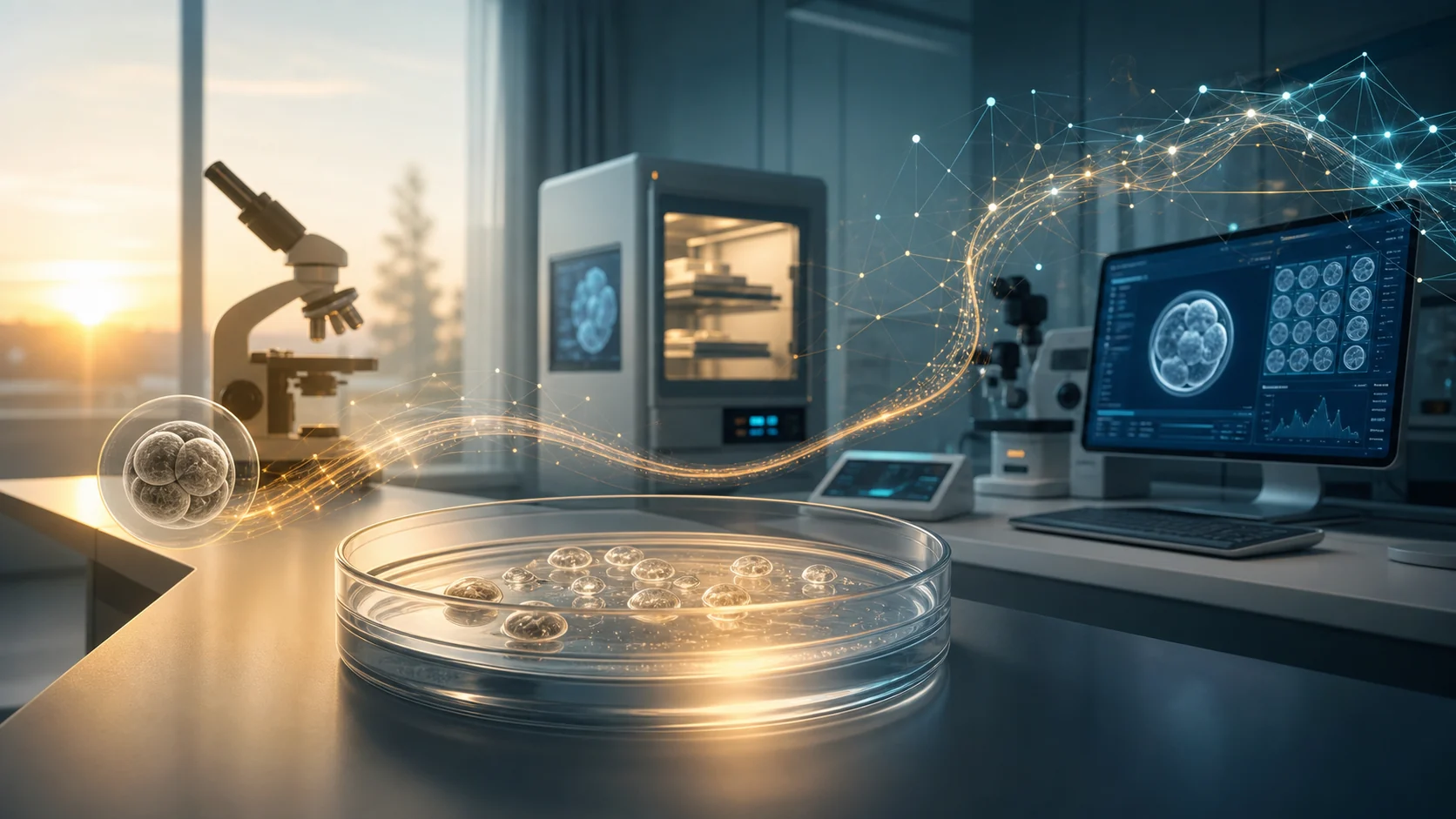
In 1978, the birth of Louise Brown proved that human life could begin outside the body and still become a healthy child. Nearly half a century later, IVF and other assisted reproductive technologies have helped millions of families worldwide.
In 2025, another milestone arrived: a peer-reviewed case report described the first live birth after fertilization using a fully automated, digitally controlled, remotely operated ICSI system. When AI and robotics begin to participate in one moment of creating life, the question is not only what technology can do, but what evidence, ethics and human responsibility must still govern it.
This article neither worships AI nor fears it. It asks a more useful question: from Louise Brown to AI embryo assessment and automated IVF laboratories, where has reproductive medicine arrived, and what must remain human?
THE ORIGIN
The beginning: the 1978 petri dish
To understand where the field is going, we must start where it began. In November 1977, an egg and sperm met in a laboratory dish in England. Nine months later, the embryo became Louise Brown, the first person conceived through IVF.
For families facing blocked fallopian tubes and other causes of infertility, the medical options at that time were extremely limited. Robert Edwards, Patrick Steptoe and Jean Purdy tried what sounded radical: fertilize the egg outside the body, culture the embryo and return it to the uterus.
Jean Purdy deserves particular recognition. She was a central embryologist in the team and among the first to observe the early embryo cells dividing. The history of IVF is not the story of one inventor alone; it is a story of scientists, clinicians, embryologists and patients carrying uncertainty together.
| Date | 25 July 1978 |
| Place | Oldham General Hospital, United Kingdom |
| Team | Robert Edwards, Patrick Steptoe and Jean Purdy |
| Method | Natural-cycle IVF |
| Legacy | Robert Edwards received the 2010 Nobel Prize in Physiology or Medicine for developing IVF |
Louise Brown's birth changed medicine, but it also changed what hope could mean for families.
FOUR DECADES
From achieving pregnancy to doing it better
If 1978 answered whether IVF could work, the next four decades asked a harder question: how can it become safer, more precise and more controllable?
The progress of IVF has never been a single miracle. It came from stimulation protocols, embryology laboratories, cryopreservation, genetic testing, imaging, quality control and better clinical judgment advancing together.
First IVF live birth demonstrated the feasibility of fertilization outside the body.
Embryo freezing made it possible to preserve embryos for later transfer.
ICSI addressed severe male-factor infertility by injecting a single sperm into an egg.
PGT helped screen embryos for chromosomal or genetic risks in selected cases.
Vitrification improved survival after freezing and thawing eggs and embryos.
Time-lapse imaging and incubator monitoring made embryo development more visible.
AI embryo assessment and laboratory automation began to move from research into early clinical use.
ENTER AI
When algorithms begin to look at embryos

Embryo selection has long depended on expert visual assessment. Before transfer, embryologists evaluate morphology and development, then rank embryos by likely potential. The challenge is subjectivity: different experts may rank the same cohort differently, and human fatigue can affect consistency.
AI is useful precisely where the visual information is richer than the eye can fully process. It can analyze static images, time-lapse videos and clinical variables, then convert subtle developmental patterns into scores or rankings.
Systems such as iDAScore, ERICA, IVY and DeepEmbryo have been studied or applied in IVF contexts. The DeepEmbryo study used three static embryo images from different post-insemination time points and reported prediction accuracy up to about 75%, while emphasizing compatibility with many existing lab workflows.
These findings should remain in context. External validation, multicenter data, model explainability and actual live-birth outcomes matter more than a single accuracy number. AI is best understood as a powerful assistant, not as the final decision-maker.
More objective
It can reduce variability in purely visual morphology assessment.
More continuous
It can integrate development over time rather than a single snapshot.
More measurable
It can turn complex signals into comparable scores.
Still limited
Clinical benefit must be proven in robust real-world studies.
THE FIRST
A milestone: the first live birth after automated remotely operated ICSI
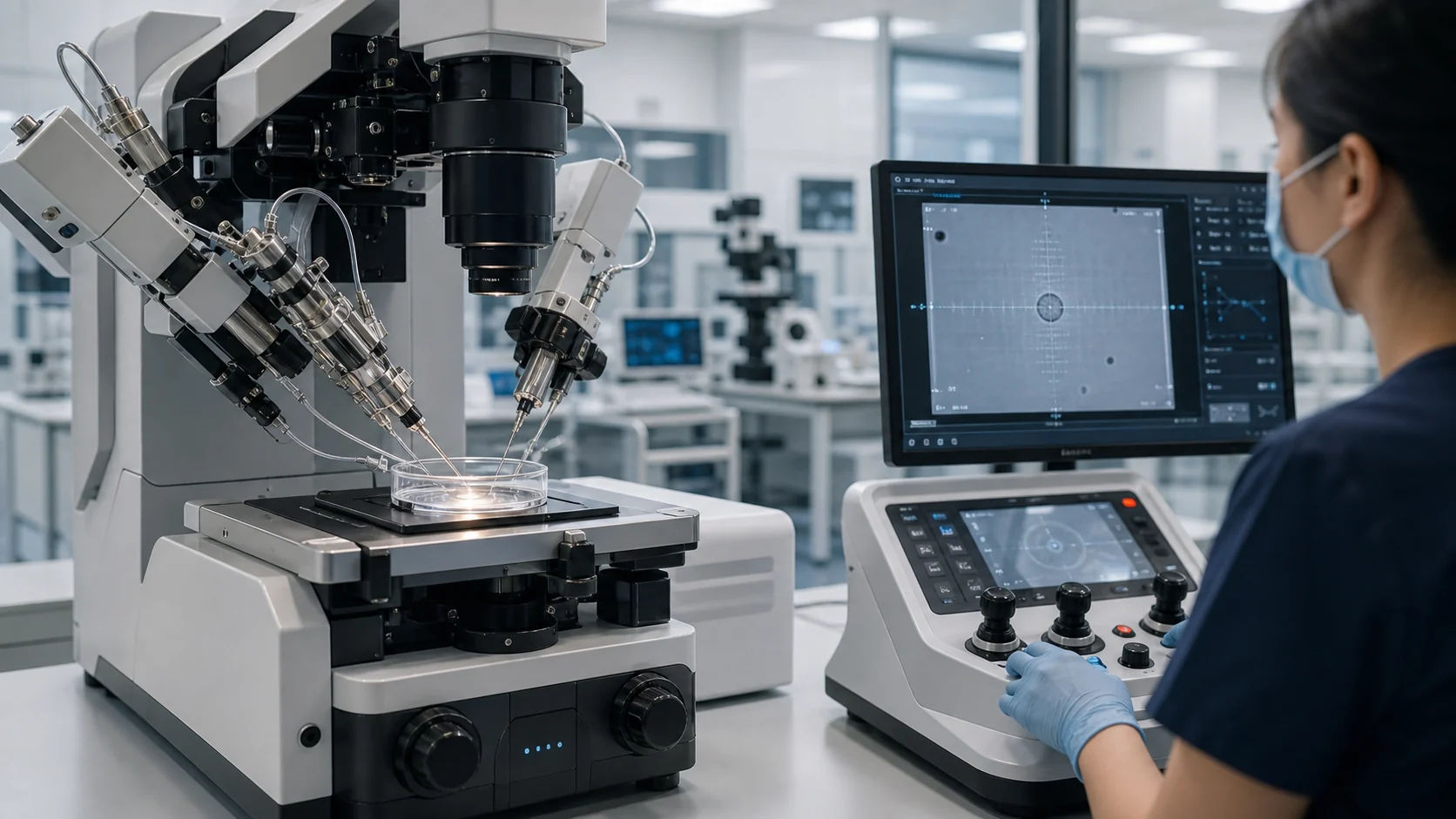
In April 2025, Reproductive BioMedicine Online reported a first live birth after fertilization using a fully automated, digitally controlled, remotely operated ICSI system.
ICSI has been a core assisted reproduction technique since the 1990s: an embryologist injects a single sperm into an egg. Manual work allows flexibility and expert control, but it also varies with training, fatigue and individual technique.
The reported system automated 23 micro-steps of standard ICSI under AI or remote digital control. Public reports describe remote operation across approximately 3700 km. In the study, five eggs underwent automated ICSI, four fertilized normally, one developed into a blastocyst, and a later transfer resulted in a healthy male baby.
The boundary is just as important as the achievement. This was a case report and an early feasibility milestone, not a mature replacement for embryologists. Human oversight remained present; what changed was the interface between human expertise, algorithms and robotic precision.
From the first IVF baby in 1978 to a robotic ICSI live birth in 2025, one moment of creating life moved into collaboration between human supervision, algorithms and microrobotics.
FIVE FRONTIERS
Five places where AI is changing assisted reproduction
AI in reproductive medicine is not only embryo ranking. It is entering multiple stages of the IVF pathway. Families should ask what problem each tool solves, what evidence supports it, and who remains responsible for decisions.
Personalized stimulation
Using age, hormones, ovarian reserve and prior response to support dose and monitoring decisions.
Gamete assessment
Making sperm and egg evaluation more standardized and repeatable.
Embryo ranking
Combining image, morphokinetic, genetic and clinical signals to support transfer planning.
Outcome prediction
Helping doctors and patients discuss probabilities and shared decisions more clearly.
Laboratory automation
Monitoring culture conditions, workflow and key performance indicators with less manual variation.
DEEPER QUESTIONS
Four questions between efficiency and care

Efficiency and warmth
Automation can improve precision, but fertility care is not a factory line.
Standardization and individuality
Big data seeks patterns, while each patient has a distinct body, history and values.
Black boxes and consent
If no one can explain why an embryo was recommended, informed consent becomes weaker.
Can versus should
Every new capability needs boundaries set by law, ethics and social responsibility.
Technology can show how far we can go. Humanity, ethics and law must decide where we should go.
WHAT AI CANNOT
Cautious optimism: what AI cannot replace
AI can analyze embryos, but it cannot understand how many years a family has waited. It can calculate probabilities, but it cannot absorb the grief of a failed cycle or the joy of a long-awaited pregnancy.
Medicine is never only technology. AI is a powerful tool, but it remains a tool. Accountability, empathy, explanation and final responsibility must stay with people.
From the dim light of a petri dish in 1978 to the precision of AI-assisted micromanipulation today, technology has traveled far. The original wish has not changed: to help love continue and waiting receive an answer.
FAQ
Can AI embryo assessment replace embryologists?
No. It can provide quantitative support, but final decisions require embryologists, physicians, patient context and ethical judgment.
Is automated ICSI ready for routine use?
No. The 2025 report is a case report and feasibility milestone. Larger studies are still needed.
Can AI improve IVF success rates?
It may improve consistency and efficiency, but live-birth benefit must be proven in robust clinical studies.
What should patients ask?
Ask how the AI was validated, how clinicians use it, how results are explained, and who is responsible when uncertainty appears.
References
This article is based on peer-reviewed papers, institutional reports and public medical-science sources.
- Encyclopaedia Britannica: Louise Brown
- Nobel Prize 2010: Robert G. Edwards and the development of IVF
- The current status of IVF, EClinicalMedicine, 2023
- ICMART reports and publications on ART
- Reproductive BioMedicine Online: automated remotely operated ICSI first live birth
- EurekAlert / RBMO: world's first birth following fully automated remotely operated ICSI
- Frontiers in Artificial Intelligence: DeepEmbryo algorithm for embryo selection
- Biology: Artificial Intelligence in IVF Laboratories
- Biology: Artificial Intelligence in Routine IVF Practice
Understand the technology before planning your pathway
If you are comparing IVF, PGT-A, embryo assessment, donor eggs or cross-border fertility options, first organize your medical background, embryo status, documents and family goals.
Request a pathway reviewThis article is educational and does not constitute medical diagnosis, treatment advice, legal opinion or a success guarantee.