

Higher body weight is genuinely associated with reproductive problems. In women it can contribute to anovulation, longer time to conception, more difficult fertility procedures and higher pregnancy risks. In men it may affect hormones, semen parameters and sperm DNA integrity. Improving diet, activity, sleep and metabolic health as a couple is therefore a legitimate part of preconception care.
Association, however, is not the same as a single cause, and it does not mean treatment must be withheld until someone reaches a particular number on the scale. Trials show that lifestyle intervention can improve weight, metabolism and pregnancy rates in some groups, yet it has not consistently increased live-birth rates across all women with overweight or obesity and infertility. For older women, diminished ovarian reserve, long-standing infertility, bilateral tubal obstruction or severe male factor, an open-ended delay may trade irreversible reproductive time for limited weight loss.

1. Separate ovulation, pregnancy and live birth
Three outcomes are often collapsed into one: whether ovulation occurs or usable sperm are produced; whether a clinical pregnancy begins; and whether that pregnancy ends in a live birth. Lifestyle change may regularize cycles, restore ovulation and increase unassisted conception. But chromosomes, tubes, the uterine environment, placentation and pregnancy safety still stand between conception and birth.

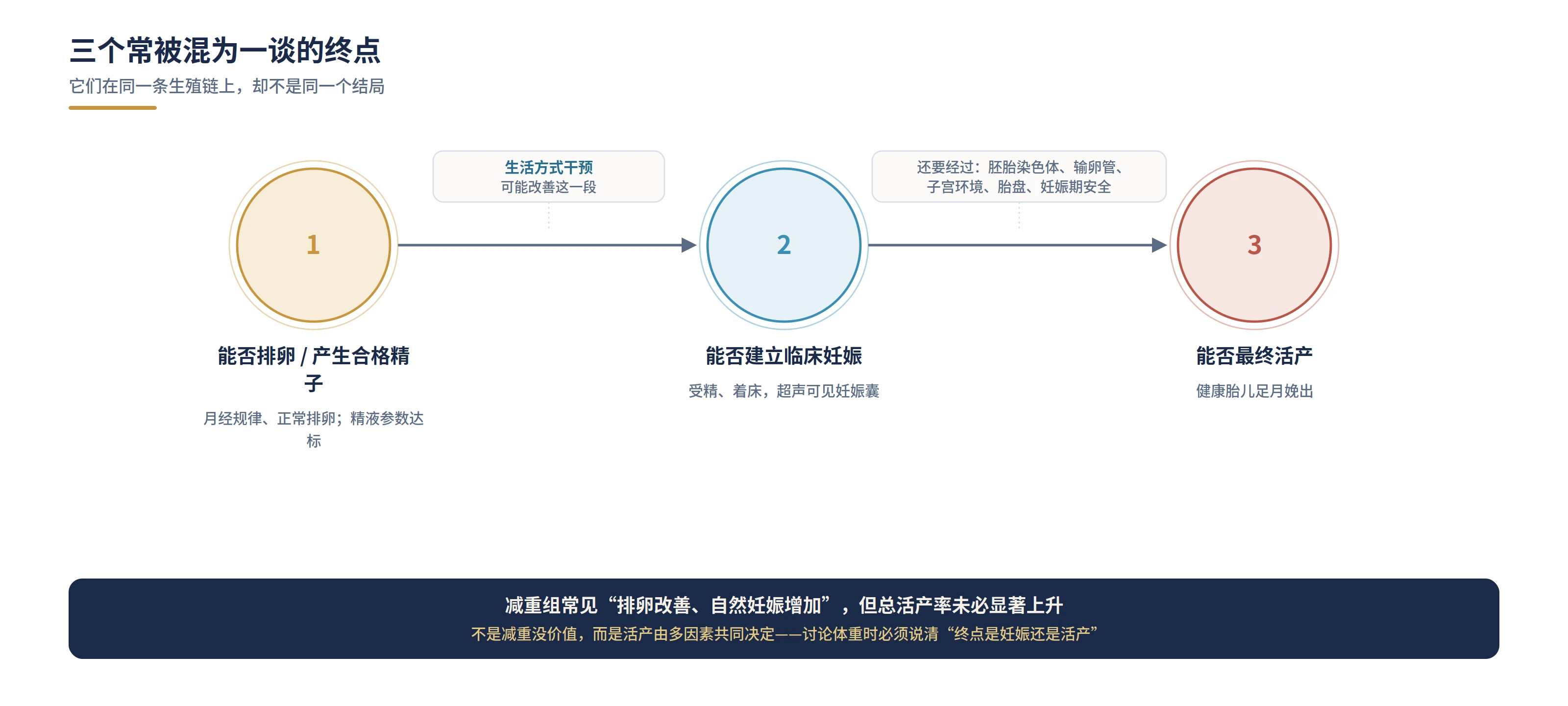
This is why studies can look contradictory. A weight-loss group may have better ovulation, more unassisted pregnancies and less metabolic syndrome without a higher total live-birth rate. Weight loss was not useless; live birth is simply controlled by more variables, including when fertility treatment begins. A study of anovulatory PCOS cannot automatically answer the same question in ovulatory unexplained infertility.
BMI is a useful population screen, not a direct measure of fat distribution, muscle mass or metabolic health. Chinese adult thresholds define overweight as BMI 24.0 to under 28.0 kg/m² and obesity as BMI at least 28.0 kg/m². Clinical risk also depends on waist circumference, blood pressure, glucose, lipids, fatty liver, sleep apnea and previous pregnancy complications. The first WHO global infertility guideline places lifestyle advice inside person-centered evaluation and treatment rather than making weight a universal gate.
2. How obesity can affect female fertility
In PCOS, insulin resistance and compensatory hyperinsulinemia can increase ovarian androgen production and reduce hepatic sex hormone-binding globulin. More free androgen may disrupt follicular development, producing infrequent periods, anovulation or irregular ovulation. Weight gain can amplify this loop, but PCOS is not caused by eating too much; lean women can also have it, and genetic, neuroendocrine and ovarian mechanisms contribute.
Women with overweight or obesity and anovulatory PCOS are the group most likely to gain a direct fertility benefit from moderate weight loss and activity. The 2023 international PCOS guideline also stresses that healthy behavior improves metabolic health and quality of life even without visible weight loss, and no single dietary composition is superior for every patient.

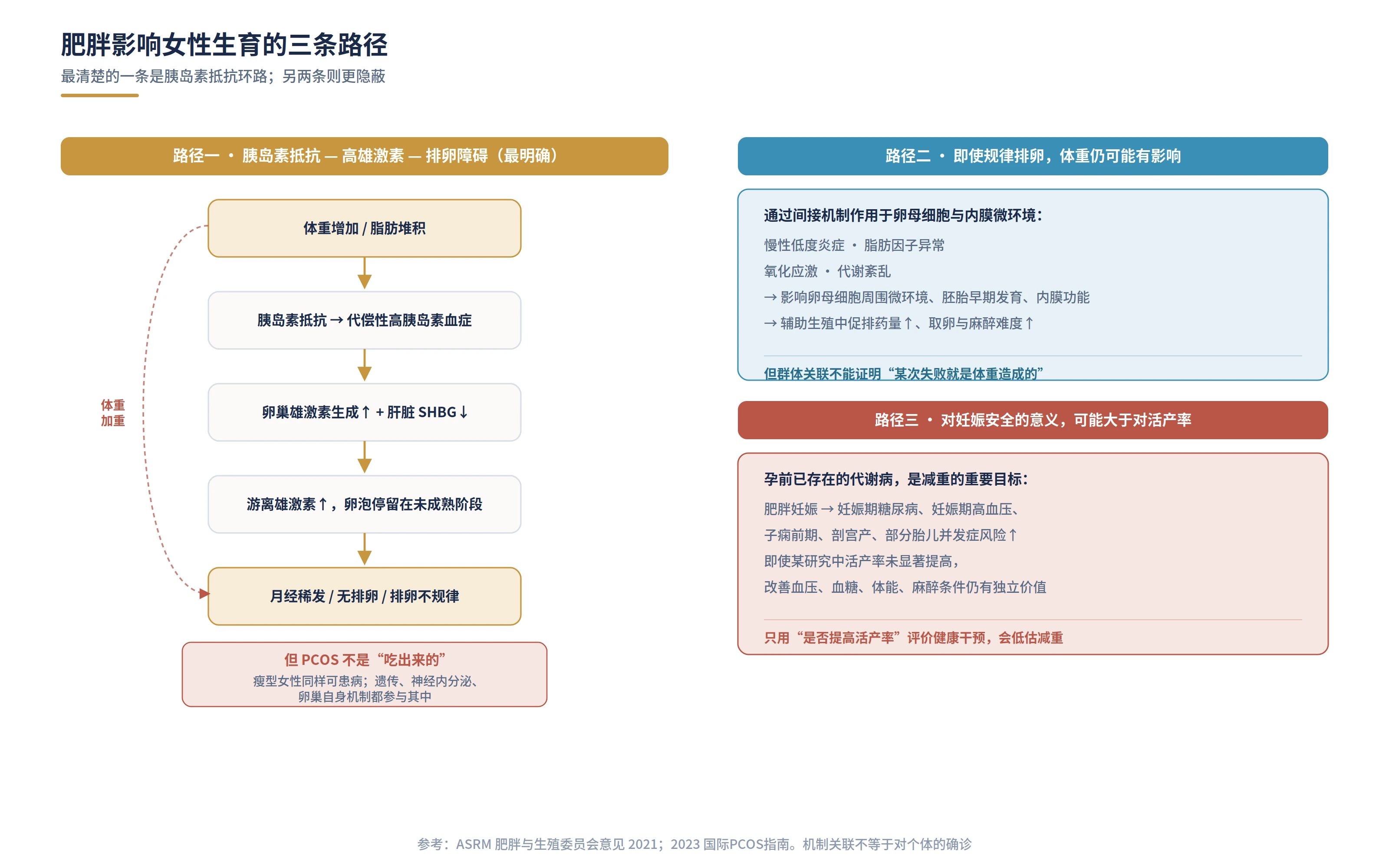
Even with regular ovulation, obesity may affect the oocyte environment, early embryo development and endometrial function through low-grade inflammation, adipokine changes, oxidative stress and metabolic disturbance. It can also increase medication requirements and make retrieval or anesthesia more difficult. These mechanisms and population associations cannot prove that weight caused an individual failed cycle, nor do they exclude tubal, uterine, embryonic or male causes.
ASRM notes that obesity increases reproductive and obstetric risk, while most women with obesity remain fertile. In ovulatory infertility, weight loss before treatment has not been shown to improve live birth. Any delay must be compared with age-related fertility decline. Weight management may still have independent value by improving diabetes, hypertension, fatty liver, sleep apnea, fitness and anesthesia safety.
3. Male weight belongs in the fertility assessment
Male obesity may be accompanied by lower testosterone, relatively higher estrogen, increased scrotal temperature, sleep apnea, sexual dysfunction and oxidative stress. A 2024 meta-analysis found that, compared with BMI below 25 kg/m², obesity was associated on average with 0.24 mL lower semen volume, 19.56 million fewer total sperm, 2.21 percentage points lower total motility, 5.95 points lower progressive motility and 1.08 points fewer normal forms. These are group averages, not a substitute for semen analysis.

Weight loss may improve male hormones, sexual function and some semen measures, but high-quality intervention studies remain limited and cannot promise more natural conceptions or live births. Both partners should be assessed together. Severe oligoasthenoteratozoospermia or azoospermia should not be left untreated while someone waits several months to lose weight.
A reported association between paternal obesity and autism does not prove causation. A Norwegian cohort observed autistic disorder in about 0.27% of children of fathers with obesity versus 0.14% with normal weight, adjusted odds ratio 1.73. Genetics, family environment and residual confounding may still explain part of the association.
4. Is obesity the most common cause of biochemical pregnancy or early miscarriage?
No. Obesity is associated with miscarriage and recurrent pregnancy loss, but embryonic chromosomal abnormality remains the leading known mechanism of early loss. ASRM's 2026 opinion states that about 50%-60% of first-trimester miscarriages are related to embryonic aneuploidy, with risk rising as oocyte meiotic errors increase with maternal age. One or two very early losses cannot be attributed to the couple's weight alone.
A biochemical pregnancy means hCG was detected briefly before an ultrasound-confirmed clinical pregnancy. It is not a diagnosis that reveals the cause. Chromosomes, age, uterine structure, antiphospholipid syndrome, thyroid and other endocrine conditions, and chance events must be considered from the history. Obesity is one risk background, not an exclusive diagnosis.
ESHRE recommends explaining weight-related risk and the benefits of a healthy weight, while noting that no study has shown that weight loss raises the next live-birth chance in recurrent pregnancy loss. Weight management should proceed alongside, not instead of, a guideline-based miscarriage evaluation.
5. Why pregnancy can increase without a proven live-birth gain
FIT-PLESE randomized 379 women with obesity and unexplained infertility. After 16 weeks, the intensive group lost 6.6% on average versus 0.3% in the activity-focused comparison. Metabolic syndrome fell from 52.8% to 32.2%, yet healthy live birth was 12.2% versus 15.2%, with no significant difference.
The LIFEstyle trial enrolled 577 infertile women with BMI at least 29 kg/m². Six months of lifestyle intervention before treatment did not improve the main 24-month live-birth outcome compared with prompt fertility treatment: 27.1% versus 35.2%. The intervention group conceived unassisted more often and used less fertility treatment, but took longer from randomization to birth.
A 2024 meta-analysis found more pregnancies after preconception weight-loss intervention, pooled RR 1.24. Live birth was RR 1.19 with a 95% confidence interval crossing no effect, and miscarriage was not clearly improved. Current evidence supports benefits for conception and metabolism more strongly than a universal live-birth benefit.
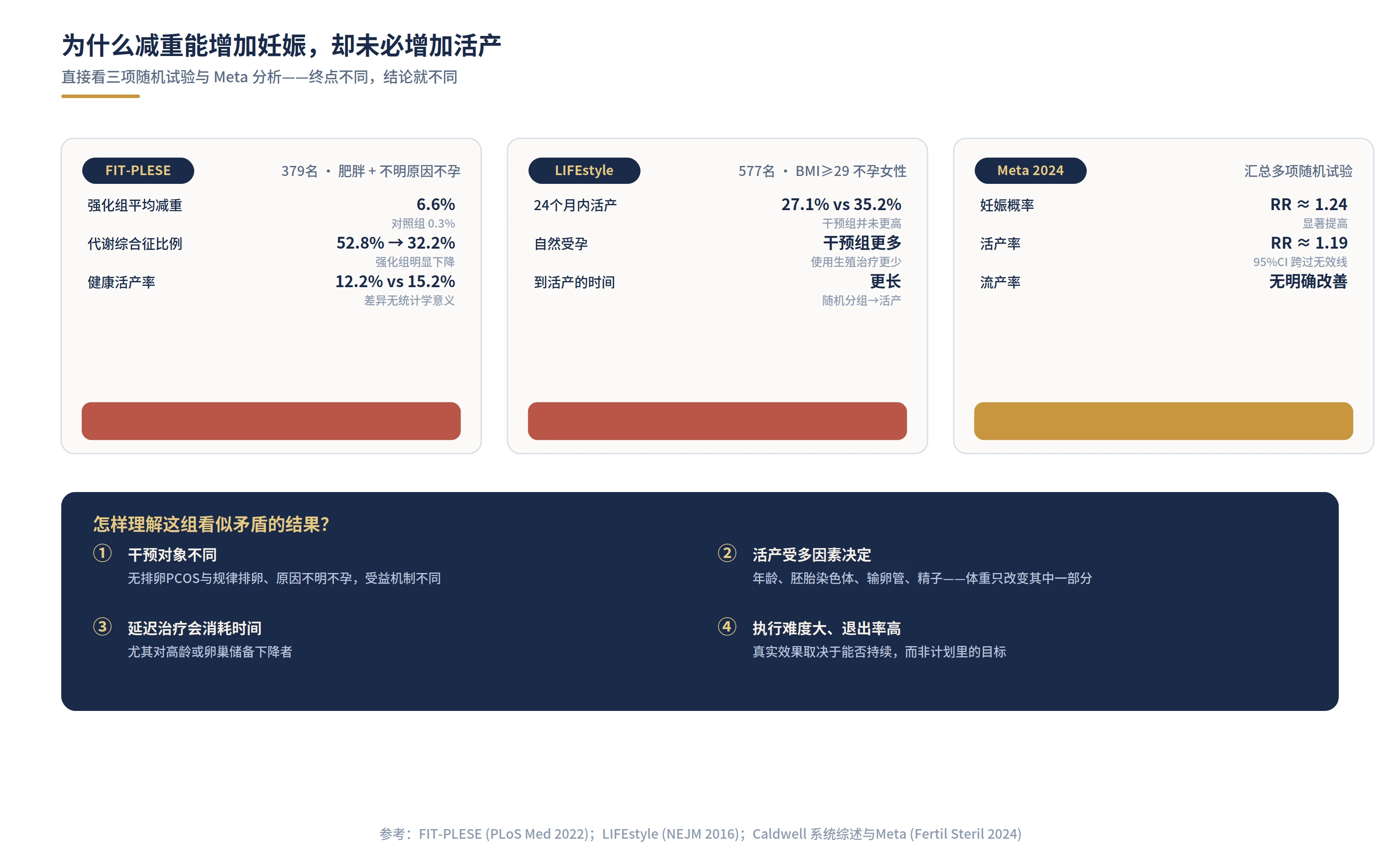
The results differ because populations differ; anovulatory PCOS and ovulatory unexplained infertility do not share the same mechanism. Live birth also depends on age, chromosomes, tubes and sperm. Delayed treatment has a time cost, and intensive lifestyle programs have substantial dropout and adherence challenges.
6. Who may use a weight-loss window, and who should not only wait?
A time-limited lifestyle window can be reasonable for a younger person with adequate ovarian reserve and tubal status, obesity-related anovulation, or metabolic and anesthesia risks that need optimization. Its goal is not indefinite pursuit of a normal BMI. Goals may include restored ovulation, better glucose or blood pressure, sustainable habits and safer treatment, with a review date agreed in advance.
Weight loss should not become the only prerequisite when age-related decline is significant, AMH or antral follicle count suggests reduced response, infertility is long-standing, both tubes are blocked, a major uterine or male factor exists, or fertility preservation is urgent. Lifestyle care can continue while diagnostic work and treatment planning move forward.

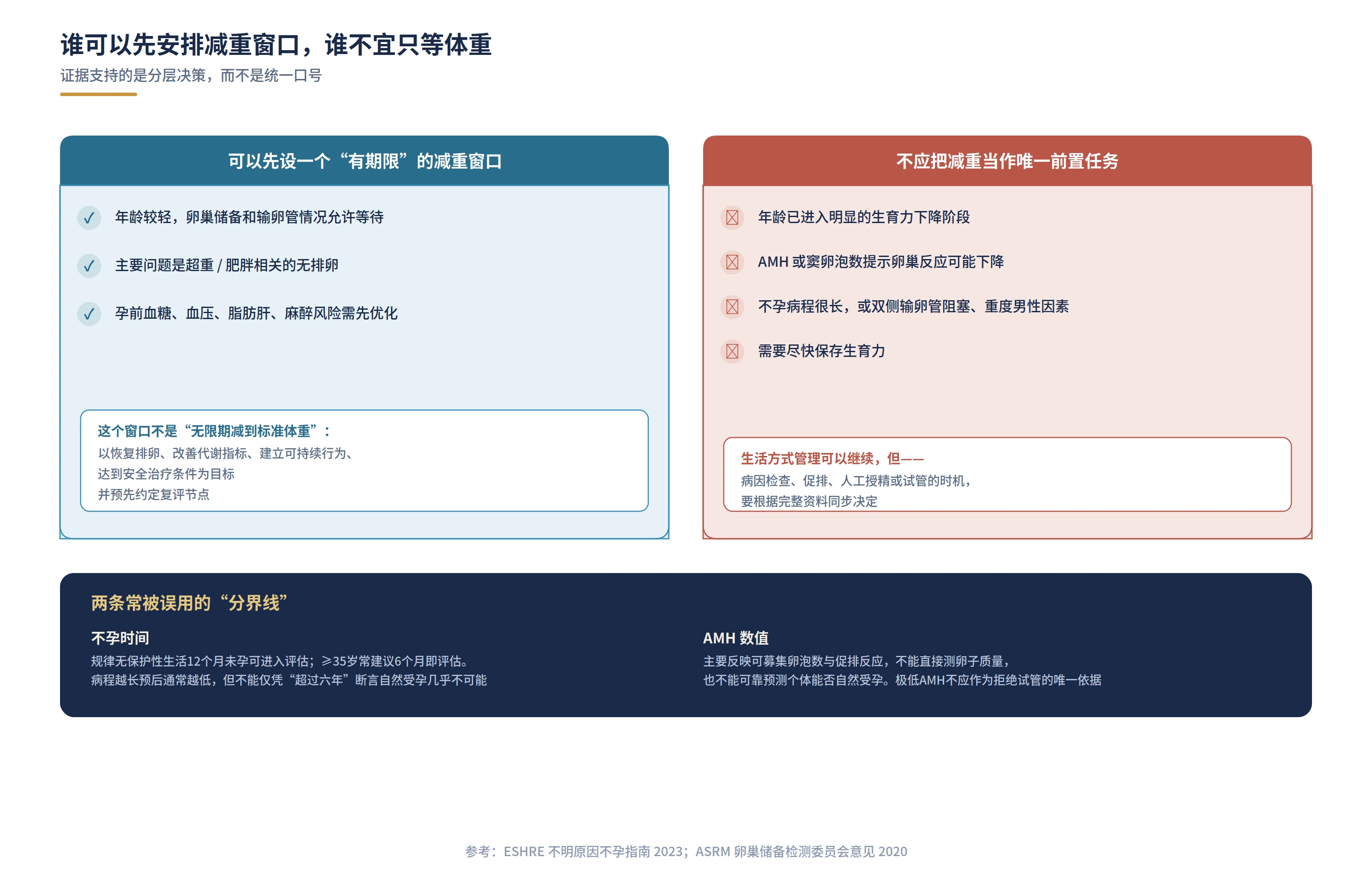
Infertility duration is not a mechanical cutoff. Evaluation is generally appropriate after 12 months of regular unprotected intercourse, after six months for many women age 35 or older, and earlier when a known risk exists. AMH is not a universal treatment dividing line either: it predicts oocyte quantity and stimulation response better than egg quality or natural conception, and should be interpreted with age and the full clinical picture.
7. How couples can manage weight together
Start with parallel metabolic and reproductive assessment. For women this includes cycles and ovulation, age and ovarian reserve, uterus and tubes, plus blood pressure, glucose, lipids, liver health and sleep apnea where indicated. Men need metabolic review and semen analysis when appropriate. The purpose of weight loss should be explicit: restore ovulation, reduce pregnancy risk, improve procedure safety or support long-term health.


The target is a sustainable energy deficit, not starvation. Eliminating all rice or starch, copying an athlete's diet or using severe restriction is not standard care. A workable pattern reduces sugary drinks and energy-dense snacks, limits highly processed takeout, protects protein, vegetables, whole grains or an appropriate staple portion, and uses regular meals and portion tracking to create a modest persistent deficit.
No diet composition has been declared universally best for PCOS. A 16:8 eating window can be an adherence tool for some people, not a specific infertility treatment. It is unsuitable when it triggers binge eating, hypoglycemia, cycle disruption, inadequate nutrition or poor sustainability. The rate of loss must be individualized.
Combine aerobic and resistance activity, progress from current capacity, and address sleep apnea or chronic sleep loss. Protect folate and essential nutrients. Very-low-calorie diets, unregulated products, self-prescribed weight-loss drugs and trying to conceive immediately after rapid loss can create new risks. Medication or bariatric surgery requires coordinated contraception, washout and conception planning with obesity and fertility specialists.
8. Takeout, sweet drinks, plastic containers and microplastics
Reducing high-sugar drinks and energy-dense takeout has clear nutritional and metabolic justification. Evidence about food containers and microplastics is narrower. A 2024 review reported microplastic detection in reproductive tissues such as placenta and meconium, but human studies were small, methods inconsistent and clinical outcomes rarely assessed. It cannot show that one ordinary container exposure causes infertility or miscarriage.
Reducing unnecessary single-use plastic, avoiding unsuitable plastic for very hot food and choosing compliant containers are reasonable low-cost precautions. They do not replace assessment of ovulation, tubes, semen or embryos and should not be presented as a proven cause of years of infertility.
9. Reduce the decision to four questions

Is there an ovulation disorder? How much time does the reproductive window allow? What is the medical goal of weight loss? Is there a cause that must be treated at the same time? Tubal obstruction, uterine disease, reduced ovarian reserve and major semen abnormalities do not disappear while someone waits to lose weight.
10. Practical priorities in common situations
| Clinical situation | Main value of weight loss | Can observation come first? | What must happen in parallel |
|---|---|---|---|
| Young, overweight/obesity, PCOS with anovulation | Improve metabolism, cycles and ovulation | A time-limited window may fit | Tubal, semen and metabolic assessment; review on schedule |
| Regular ovulation, unexplained infertility | Health and pregnancy safety; live-birth gain unproven | Depends on age and duration | Complete both-partner evaluation and prognosis |
| Older age or possibly reduced reserve | Metabolic and procedural safety | Usually do not wait on weight alone | Lifestyle and fertility treatment planning together |
| Severe male factor or bilateral tubal obstruction | Overall health; possible male parameter gains | Weight loss must not replace treatment | Prompt andrology or ART assessment |
| Recurrent pregnancy loss with obesity | General obstetric and metabolic risk | Do not postpone the loss workup | Guideline-based evaluation; explain evidence limits |

Conclusion: move both tracks forward
Obesity can change reproductive and pregnancy risk, and shared lifestyle improvement has real health value. It may restore ovulation and increase unassisted conception for some people. But weight cannot explain every case of infertility, biochemical pregnancy or miscarriage, and trials do not support delaying every woman's treatment until weight loss occurs.
Put weight, metabolic health and reproductive time in one plan
FS helps families organize age, ovulation, ovarian reserve, tubes, semen, metabolic conditions and previous treatment into a pathway for discussion. This article is not a substitute for medical care.
Sources
Key figures were checked against public guidelines, randomized trials and peer-reviewed research. The WHO guideline was published in November 2025.
- World Health Organization. Guideline for the prevention, diagnosis and treatment of infertility, 2025.
- ASRM Practice Committee. Obesity and reproduction: a committee opinion, 2021.
- International Evidence-based Guideline for the Assessment and Management of PCOS, 2023.
- Caldwell AE, et al. Preconception weight loss interventions and fertility: systematic review and meta-analysis, 2024.
- Legro RS, et al. FIT-PLESE randomized controlled trial, 2022.
- Mutsaerts MAQ, et al. Randomized trial of a lifestyle program in obese infertile women, 2016.
- Li Y, et al. Body mass index and semen quality: systematic review and meta-analysis, 2024.
- Surén P, et al. Parental obesity and risk of autism spectrum disorder, 2014.
- ASRM Practice Committee. Recurrent pregnancy loss: a committee opinion, 2026.
- ESHRE. Recurrent Pregnancy Loss guideline update, 2022.
- ASRM Practice Committee. Testing and interpreting measures of ovarian reserve, 2020.
- ESHRE. Evidence-based guideline: Unexplained Infertility, 2023.
- 国家卫生健康委员会办公厅:《成人肥胖食养指南(2024年版)》.
- Hunt K, et al. Microplastic exposure and human reproductive outcomes: systematic review, 2024.
Medical information only. Weight-loss pace, diet, exercise, medication, surgery and the timing of ovulation induction or ART require individualized clinical assessment.