

In August 2026, the Supreme Council of Kyrgyzstan published a draft law that would restrict foreign intended parents' access to surrogacy services in the country. This article explains what the bill would change, how the current system works, which forces are driving reform, and—by comparing Russia, Kazakhstan and Georgia—how likely Kyrgyzstan is to move toward a comprehensive restriction.
The draft would generally limit surrogacy contracts concluded in Kyrgyzstan to Kyrgyz citizens, while preserving an exception for a Kyrgyz citizen who is formally married to a foreign citizen.
The framework analysis below retains its 2026-08-24 source-review scope: it describes conditional surrogacy arrangements and a restriction on recruiting a Kyrgyz surrogate for foreign citizens residing abroad. It is not a current individual eligibility determination.
The Bill 5007 page now states that public discussion is closed. Draft attachments remain available; the content observed on this page does not establish passage, official promulgation or commencement.
The direction of travel is consistent with regional tightening. Whether the proposal becomes law depends on its political sponsor, the legislative route and resistance from the local industry; all three currently point to a slower process in Kyrgyzstan.
| Part | Subject |
|---|---|
| PART 01 | What the bill would change |
| PART 02 | Current system: legal, with existing conditions |
| PART 03 | Forces driving reform |
| PART 04 | Legislative process and timing |
| PART 05 | Practical effect on cross-border arrangements |
| PART 06 | Will Kyrgyzstan move toward a comprehensive ban? |
01 | What the bill would change
On 10 August 2026, the Supreme Council of Kyrgyzstan opened Bill No. 5007, registration No. 1-12662/Сл, for public discussion. It was introduced by Chyngyz Azhybaev and Bolot Ibragimov. The bill would amend Article 104(2) of the 2024 Law on the Protection of Citizens' Health by adding a citizenship condition for parties entering surrogacy contracts in Kyrgyzstan.[1][2]
The proposed addition contains two sentences: within the Kyrgyz Republic, surrogacy contracts would be available only to citizens of the Kyrgyz Republic; a Kyrgyz citizen who is formally married to a foreign citizen could use surrogacy services.[2]

The proposal changes intended-parent eligibility to contract. It does not comprehensively prohibit Kyrgyz citizens from using surrogacy, and it leaves the existing framework—surrogate age 20 to 35, medical-genetic consultation, a notarised contract, a licensed medical institution and birth registration—intact. If enacted as written, two foreign intended parents would no longer be eligible to enter a surrogacy contract in Kyrgyzstan.
Interpretive questions left by the mixed-nationality marriage exception
The first sentence limits contracts to Kyrgyz citizens, while the second allows a Kyrgyz citizen and a foreign spouse to use the service. The draft does not say whether the foreign spouse may be a joint contractual party, may be registered directly as a parent, or which marriage records and legalisations are required. These matters would normally be resolved during later review, in implementing rules or through administrative practice.

No provision for projects already under way
The commencement clause says only that the law would take effect on the tenth day after adoption and official publication. There is no grandfather clause, transition period or rule on continuing contracts. The text does not address notarised contracts signed before embryo transfer, projects after transfer or during pregnancy, or children born before registration is complete. This is an unresolved question: the bill does not support either an assumption of automatic invalidity or a promise that every existing project would proceed entirely under the old rules.
02 | Current system: legal, with existing conditions
The governing statute is Law No. 14 of 12 January 2024 on the Protection of Citizens' Health. Article 104 requires surrogacy to be based on a notarised contract. The contract is entered into by one or more persons intending to become parents and a woman who agrees to embryo transfer, pregnancy and birth. A properly licensed medical institution must also enter a separate notarised contract with the surrogate and assume responsibility for protecting her health during pregnancy, birth and the postpartum period.[3]
A surrogate must be 20 to 35 years old, have at least one healthy child, undergo medical-genetic consultation and give written informed consent. The intended parents bear pregnancy, birth and postpartum health expenses, with funds placed in a dedicated bank account. After birth, the party or parties to the embryo-transfer contract are registered as the parents, and they may not refuse the child before registration is completed.[3]

Current law already contains one restriction aimed at foreigners
Article 104(12)(2) prohibits searching in Kyrgyzstan or online for a Kyrgyz citizen to serve as a surrogate for foreign citizens residing outside the Kyrgyz Republic. The current system is therefore not completely open to foreign intended parents: it has no comprehensive ban on their eligibility to contract, but it expressly restricts cross-border recruitment. Bill No. 5007 continues that direction.[3]
Textual tension between two provisions
Article 57(5) says that citizens have a right to become parents through surrogacy regardless of medical indication and marital status, while Article 104(2) uses the phrase “on the basis of medical indications.” The current draft does not resolve this difference. Application still depends on regulatory rules, provider standards and case-specific documents, and the issue may be raised during later review.
03 | Forces driving reform
The explanatory note identifies protection of women and children, prevention of commercialisation, human trafficking and other abuses as its objectives, and says Kyrgyzstan is becoming a surrogacy centre for foreigners. It also acknowledges that confidentiality limits public statistics, yet provides no sourced figures on foreign contracts, resulting births, surrogate health outcomes or relevant cases.[1]
The policy objectives are clear, but the quantitative material supporting them has not been published. That does not change the fact that the bill entered public discussion, but it may affect support in committee: when necessity must be demonstrated, missing data are often the first challenge for proponents.
Demography has entered the legislative frame
The explanatory note cites a fall in births from 158,112 in 2020 to 140,419 in 2024, a decline of roughly 18,000 in four years. Putting fertility rates and surrogacy policy in the same document shows that the amendment is being discussed not only as medical regulation but also as population policy, a framing similar to earlier debates in Kazakhstan and Russia.[1][5]

Regional precedents are expressly cited
The note refers to Russia's restriction of surrogacy to its own citizens since 2022, India's tightening of foreign access and Kazakhstan's similar reform. Kazakhstan completed its amendment in 2026, requiring intended parents who use surrogacy to be married citizens. Those regional precedents are used directly as legislative references and form an important part of the proposal's background.[6]
The United States has also seen targeted restrictions on foreign intended parents. A Florida law effective in July 2026, for example, limits the enforceability of some surrogacy contracts involving citizens or residents of specified countries. Its route differs from Central Asian legislation, but the regulatory focus is the same: moving from whether surrogacy is lawful locally to who is eligible to enter the contract.[7][8]
04 | Legislative process and timing
For a Kyrgyz bill to take effect, it must pass public discussion, committee consideration, three readings, presidential signature and official publication. Bill No. 5007 entered the first stage on 10 August 2026.
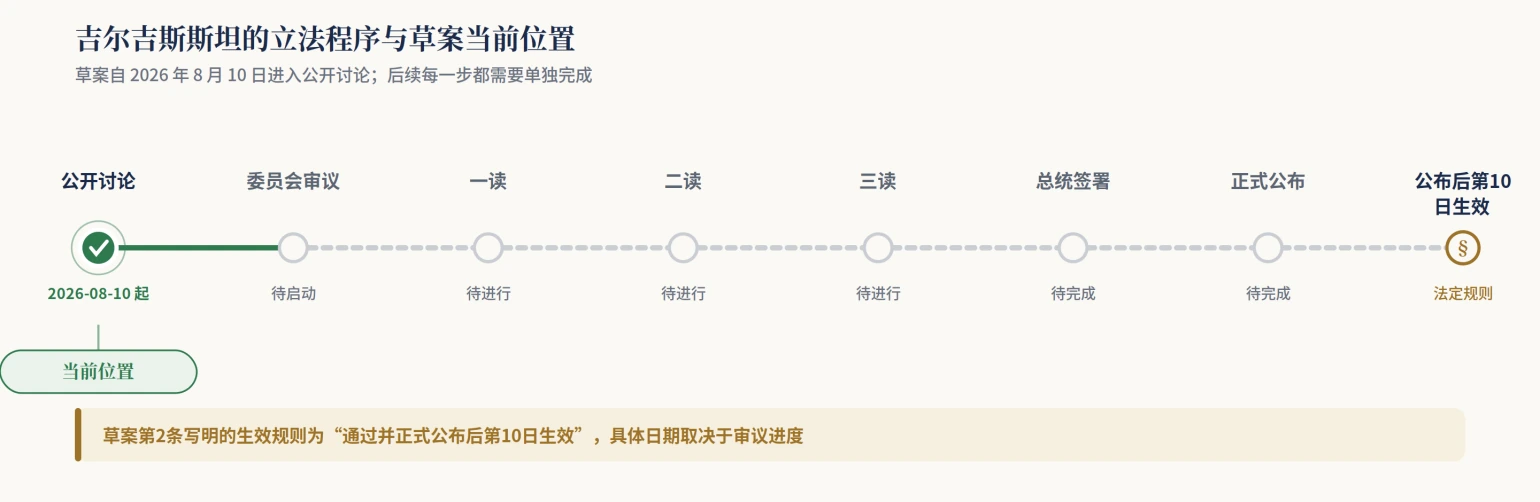
Article 2 says the law would take effect on the tenth day after adoption and official publication. This is a relative rule, not a fixed date: the effective date can be calculated only after the bill passes three readings, is signed by the president and is officially published. Until then, current law continues to apply.[2]
Three variables that may affect the timetable
The position of the government and competent authorities. A proposal sponsored by individual members often moves at a different speed from a government-backed bill. A supportive opinion from the health authority would directly affect committee momentum.
Whether the proposal is merged into another bill. Kazakhstan's equivalent restriction was inserted as an amendment into a larger bill and voted on with it. A stand-alone proposal is more likely to remain in committee for an extended period.
Treatment of existing projects and implementing rules. The absence of transition provisions and the tension between Articles 57 and 104 both require attention. Technical gaps of this kind often cause a draft to be returned for amendment.
05 | Practical effect on cross-border arrangements
Legality at the place where surrogacy is performed supplies only part of the legal foundation. A cross-border arrangement must separately address medical compliance, contract and parentage, the child's nationality, travel documents, and exit and entry. A break in any chain can delay identity registration and departure.
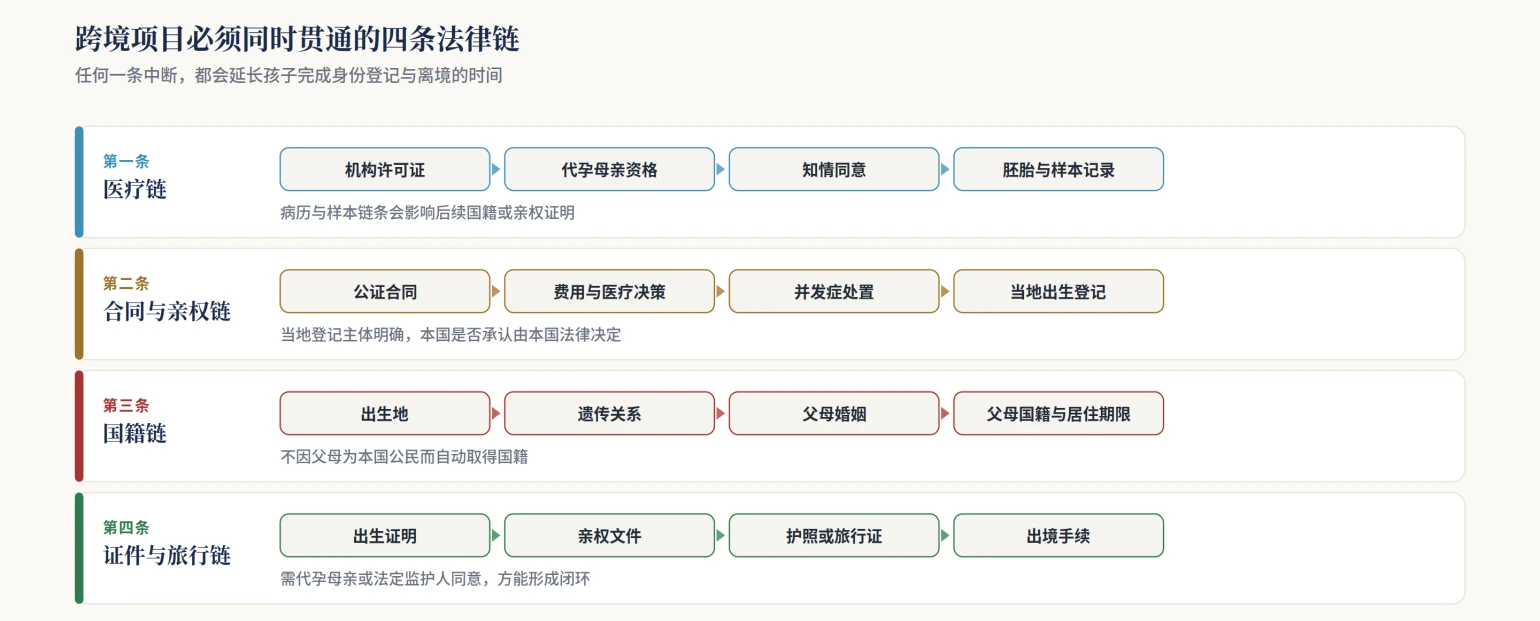
Chain one: medical care
The provider must hold the relevant licence, and the surrogate must satisfy age, prior-birth, health-assessment and informed-consent requirements. Embryo origin, genetic relationship, medical records and chain of custody may later affect nationality or parentage evidence.
Chain two: contract and parentage
A notarised contract should address expenses, medical decisions, complications, termination of pregnancy, prematurity, multiple pregnancy, stillbirth, refusal to accept the child, dispute resolution and delivery of records. Kyrgyz birth-registration rules can determine who is registered locally; whether the intended parents' home country recognises that registration remains a question of that country's law.
Chain three: nationality
Place of birth, the surrogate's identity, genetic relationship, the intended parents' marriage, nationality and residence periods may all be reviewed. A child born through surrogacy abroad does not necessarily acquire a parent's nationality automatically. Consular authorities often require proof of conception and birth, a genetic or gestational link, and legal parentage under local law.[9]
Chain four: documents and travel
The birth certificate, parentage documents, nationality determination, passport or travel document, and Kyrgyz exit formalities must form a complete chain. In some cases a child may not obtain nationality or a passport from the country of birth, and all legal parents or guardians may have to consent to issuance of a travel document.[9]

Different stages create different concerns
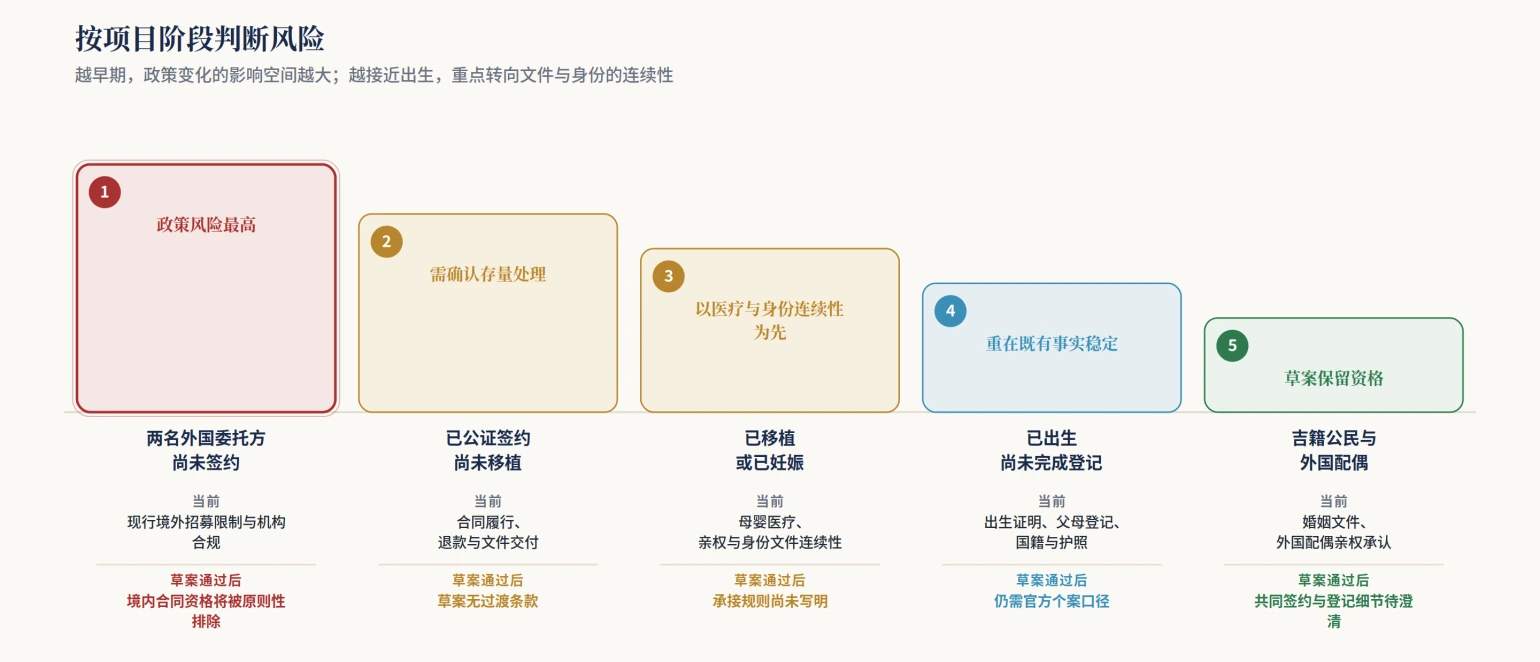
| Project stage | Main current risk | Issue if the bill is enacted |
|---|---|---|
| Two foreign intended parents; no contract yet | Current overseas-recruitment restriction and provider compliance | Eligibility to enter a domestic contract would generally be excluded |
| Notarised contract signed; no transfer yet | Performance, refunds and delivery of records | No transition clause; treatment of existing contracts would need confirmation |
| Post-transfer or pregnant | Continuity of maternal and fetal care, parentage and identity records | Best interests of the child would normally carry weight; no transition rule is written |
| Child born; registration incomplete | Birth certificate, parent registration, nationality and passport | Focus would be on established facts and stability of the child's status |
| Kyrgyz citizen with foreign spouse | Marriage records and recognition of the foreign spouse's parentage | Use remains permitted, but joint-contract details are unresolved |
For projects already in medical treatment, the child's best interests, the surrogate's health and existing contractual relationships would normally be central to any transition. Because the bill provides no transition arrangement, neither “old projects are certainly unaffected” nor “every project becomes invalid immediately” is supported by the text.
For a new project, placing the contract date, embryo-transfer date, expected delivery date, anticipated birth-registration date and document route on one timeline is more likely to expose problems early. Separating medical planning from the child's status can concentrate legal risk after birth.

06 | Will Kyrgyzstan move toward a comprehensive ban?
Kazakhstan completed a similar reform and Kyrgyzstan published its draft soon afterwards, making it tempting to assume that Kyrgyzstan is next. A wider comparison shows that countries seeking to restrict foreign access have produced very different results.

Two enacted examples share a method of political advancement
Russia's 2022 reform occurred in an exceptional political environment in which security concerns dominated debate, while related birth-registration and document rules were amended at the same time and space for opposition was limited. Kazakhstan's 2026 route is more instructive: its restriction on foreign intended parents did not proceed as a stand-alone bill but was inserted into a broader local-government bill and voted on with it.[6]
What the two examples share is not harsher wording. Each found a route with lower resistance—either a political environment in which opposition carried a high cost, or an amendment attached to legislation that was already moving.
Georgia produced a different result
Georgia's initial push was stronger than the situation currently seen in Kyrgyzstan. In June 2023, the then-prime minister publicly announced a prohibition on foreign access, a government-majority bill went to parliament, and the health minister said only altruistic surrogacy would remain, with 1 January 2024 announced as the intended effective date.
Three years later, the proposal remains in parliament without a completed vote. As of 2026, foreign intended parents may still legally enter commercial surrogacy arrangements in Georgia, and surrogates continue to receive contractual compensation.

Industry scale created real resistance. Georgia had developed an integrated chain of clinics, legal services, accommodation and intermediaries and generated substantial foreign-currency income. After the war in Ukraine, demand shifted further toward Georgia and the industry was larger than when the restriction was announced. Policy objectives also conflicted: a comprehensive ban would remove lawful income and regulatory visibility, push transactions into harder-to-regulate channels and work against the stated goal of protecting women. Finally, no external event forced immediate passage, so the proposal remained in the middle of the parliamentary agenda.
Placing Kyrgyzstan in this framework

Forces supporting reform are present. Regional precedents are written into the explanatory note, demographic concerns have entered the policy frame, and narratives around women's rights and trafficking readily gain support across Central Asia. Current law already prohibits recruiting Kyrgyz surrogates for foreigners abroad, so the draft extends an existing direction rather than making a sudden reversal.
Constraints are equally visible. The proposal comes from two members of parliament, and no public endorsement by the government or health authority has been identified. Bishkek has developed a network of clinics, intermediaries and supporting services, with a substantial Russian client base and bilateral considerations. The bill lacks transition rules and does not resolve the tension between Articles 57 and 104, technical issues that committees would normally require proponents to address.
Three possible outcomes
Adoption without material change. Domestic contractual eligibility would close to two foreign intended parents, with only the mixed-nationality marriage exception retained. This would likely require clear government support or inclusion in another bill that is already progressing.
Adoption after amendment. Transition rules would be added, the foreign spouse's contractual and registration status clarified, and implementing rules aligned. This preserves a route for existing projects and is the most technically complete outcome.
A prolonged period in committee. Georgia's three-year stalemate shows this is not unusual, particularly where a local industry has formed and no triggering event creates momentum.
A cross-border project needs one timeline for law, treatment and documents
Review the bill's status, contract milestones, medical progress, birth registration and return-home documents together.
Bill 5007 status dataset (JSON)
Sources and notes
Sources are ordered with official legal texts first, followed by professional interpretation and reporting. Web status was checked through 24 August 2026.
- [1] Kyrgyz Supreme Council: Bill No. 5007 public-discussion page and explanatory note
- [2] Bill No. 5007: proposed amendment and commencement clause
- [3] Kyrgyz Republic Law No. 14 of 2024, Articles 57 and 104
- [4] 24.kg report on the proposed restriction for foreign intended parents
- [5] National Statistical Committee of the Kyrgyz Republic: live-birth open data
- [6] Kazakhstan Law No. 350-VIII of 2026
- [7] Florida Legislature: HB 905 summary, Chapter 2026-66
- [8] ASRM: Current landscape of international intended-parent exclusion laws
- [9] U.S. Department of State: Assisted Reproductive Technology and Surrogacy Abroad
This policy analysis and general legal education reflect information available on 24 August 2026. It is not medical, legal, immigration or nationality advice for any individual case. Counsel in the place of treatment and in the intended parents' country, licensed medical providers and relevant consular authorities should each verify the route. The bill, implementing rules and national policies may change. Seven scene images are AI-generated concepts and do not depict real people, institutions, legislators or medical settings; data graphics were prepared from the listed public sources.