Case Study · Legal Closure
Does Birth in Kyrgyzstan Make a Surrogacy Case Legal? A Legal Closure Case Study
A legal surrogacy country does not legalize a project merely because birth happens on its territory. The legal chain must be created inside the local system from the right steps.
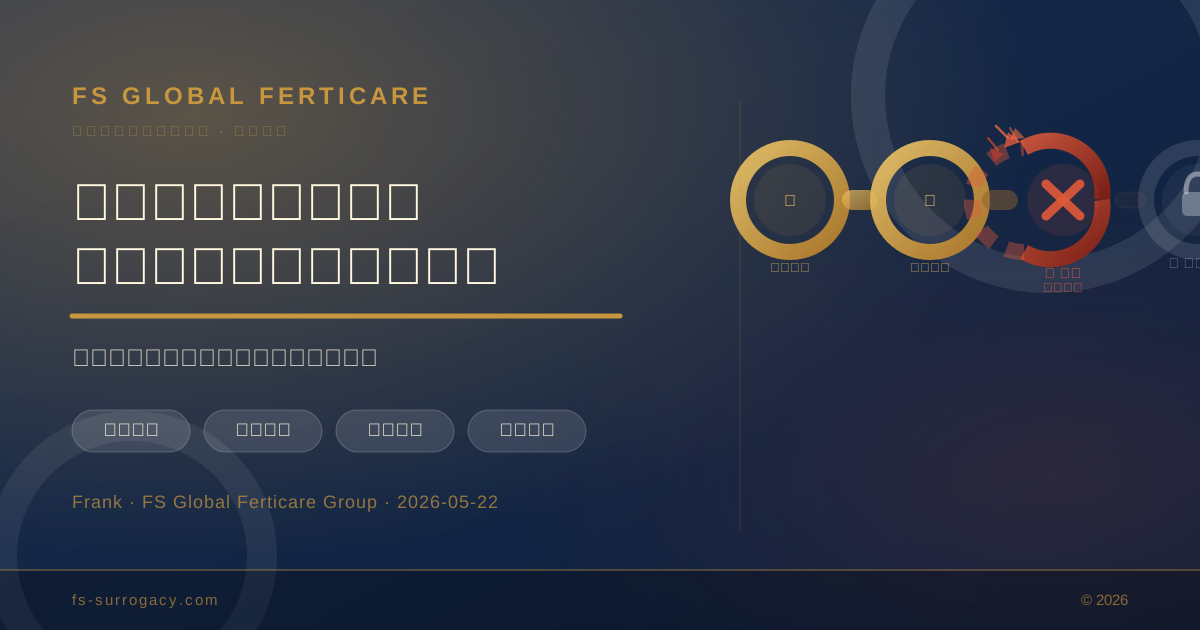
A common emergency question is whether a pregnancy started under one country's surrogacy framework can be "rescued" by moving the pregnant surrogate to Kyrgyzstan for delivery.
The answer is usually no. Kyrgyzstan's legal-surrogacy recognition depends on a local legal and medical chain, not only the geography of birth.
Case Study · Legal Closure
The case that triggered the question
Intended parents had started a surrogacy program in Georgia. Donor eggs were used, embryos were transferred and the surrogate became pregnant. Later, the surrogate, a Kenyan citizen, could not remain in Georgia and was told to return to Kenya for delivery.
The parents asked whether she could instead come to Kyrgyzstan, where surrogacy is legal, and deliver there so the child could receive a Kyrgyz surrogacy birth record naming the intended parents.
Case Study · Legal Closure
The four-part logic of legal closure
A Kyrgyz legal surrogacy pathway is not only the final birth event. It requires the surrogacy agreement to be signed within the Kyrgyz legal framework, the assisted-reproduction procedure to be performed in the appropriate medical system, pregnancy management and records to be linked to that framework, and birth registration to rely on that full chain.
If the agreement, embryo transfer and pregnancy file were created elsewhere, the Kyrgyz registrar has no local surrogacy chain to rely on.
| Legal node | Why it matters |
|---|---|
| Agreement | Creates the local legal basis. |
| Medical procedure | Connects embryo transfer to the local ART framework. |
| Pregnancy records | Shows continuity of the surrogate program. |
| Birth registration | Uses the chain to name the intended parents. |
Case Study · Legal Closure
What Apostille can and cannot do
Apostille can confirm that a foreign public document is authentic for use abroad. It cannot change the legal nature of the underlying act. A foreign surrogacy file does not become a Kyrgyz local surrogacy file merely because it is apostilled.
In other words, document authentication is not legal-framework transplantation.
Case Study · Legal Closure
What if the surrogate only enters Kyrgyzstan to give birth?
Without a complete local surrogacy chain, the likely legal treatment is simple: a foreign pregnant woman gave birth in Kyrgyzstan. Birth registration would generally follow the woman who delivered the child, not a foreign intended-parent arrangement created elsewhere.
The result may be materially similar to giving birth in the surrogate's own country: the intended parents still need to solve parentage and travel documents through the actual applicable legal framework.
Case Study · Legal Closure
Practical advice
If pregnancy has already started in another country, do not rely on changing the delivery location to repair parentage. Work within the existing legal framework and assess the child's identity, travel and return-home options.
If the project has not started, keep the agreement, medical procedure, pregnancy management and birth registration inside one coherent jurisdiction from the beginning.
FAQ
Does giving birth in Kyrgyzstan make a surrogacy project Kyrgyz?
No. The legal chain must be created under the Kyrgyz framework, not only the delivery location.
Can Apostille solve the problem?
No. Apostille authenticates documents but does not convert a foreign surrogacy process into a local one.
What should families do before starting?
Verify that contract, medical procedure, pregnancy records and birth registration can all close within the same legal framework.
Sources
Review your pathway before you commit
If your case involves IVF, donor materials, surrogacy, documents or cross-border return planning, organize the medical and legal chain before comparing packages.
Request a pathway reviewThis article is for reproductive-health, legal and pathway education only. It is not medical diagnosis, legal advice or a success guarantee. Individual decisions require physician and legal review.