Public Record · Ethics
Underground Surrogacy and Illegal ART Reports in Mainland China, 2024-2026: A Public Timeline
This timeline does not endorse any illegal route and does not prejudge unresolved cases. It places public reports on one page so the policy conversation has a clearer baseline.
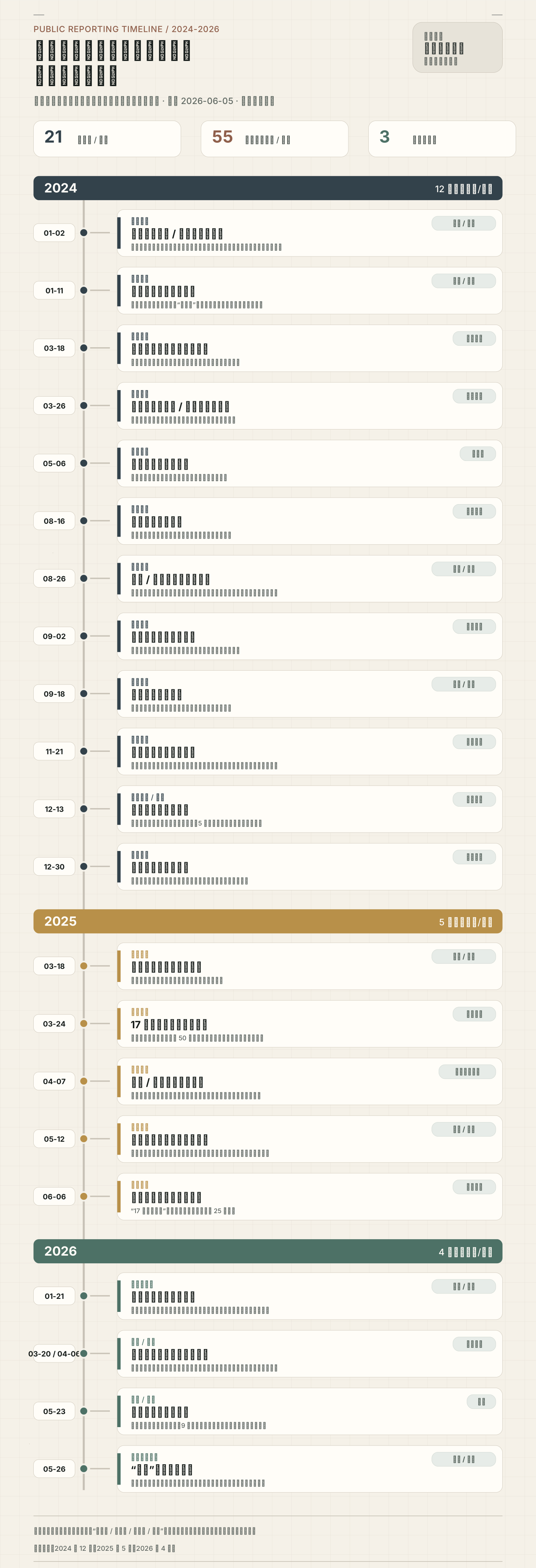
From 2024 to mid-2026, reports about underground surrogacy, illegal egg retrieval, donor-egg chains, unlicensed embryo laboratories and abnormal birth-certificate handling repeatedly entered public view.
Some cases involve clear profit-seeking and unlawful conduct. Others also reveal families who felt trapped by illness, age, loss or identity constraints. Recording the reports is not meant to inflame the topic; it is meant to make the next discussion more grounded.
Public Record · Ethics
Method and limits
The Chinese source article groups public news, official notices and follow-up reports from 2024 to June 5, 2026. It does not turn media allegations into final legal findings. Where official action was reported, it is described as such; where the matter remains a clue, uncertainty is preserved.
This English version keeps the same boundary: public record, not legal adjudication.
Public Record · Ethics
What the three-year timeline shows
In 2024, reports clustered around birth-certificate irregularities, suspected hospital involvement, underground laboratories and illegal egg retrieval. In 2025, public attention moved through fake birth certificates, a reported minor-involved surrogacy case, villa-based sites and follow-up administrative penalties. In 2026, reports included a serious delivery complication, cross-border recruitment, villa laboratories and an underground IVF site in Hangzhou.
The repeated pattern is not one single organization. It is a chain: recruitment, customer referral, egg retrieval, embryo culture, embryo transfer, delivery and document handling can be split across different places and different actors.
Public Record · Ethics
The shared risk structure
The first risk is medical opacity. Procedures that should happen in licensed facilities with infection control, anesthesia safety, laboratory traceability and clinical records are moved into villas, rented rooms or unclear facilities.
The second risk is identity opacity. Several reports touch birth certificates, assumed identities, false paternity testing or medical-record irregularities. That moves the harm from one procedure into the child's future identity, parentage and household-registration path.
The third risk is accountability opacity. When the chain is split, nobody can easily prove who authorized what, who held the gametes, who handled the embryo, who managed pregnancy care and who bears responsibility when something goes wrong.
Public Record · Ethics
Neutral writing is not moral emptiness
Neutrality here means disciplined wording. It does not mean treating underground surrogacy as acceptable. Mainland Chinese regulation prohibits medical institutions and professionals from performing surrogacy and prohibits the trade of gametes, zygotes and embryos.
But a mature discussion also should not mock every family that falls into a gray chain. Some are desperate after repeated treatment failure, cancer, uterine absence, advanced age, child loss or other painful circumstances. Their suffering deserves to be seen even while the black box is rejected.
Public Record · Ethics
Why limited, regulated exceptions remain a serious question
A simple ban without a credible legal channel may push demand into underground markets. An unprepared full opening may turn pregnancy into a product and place the body risk on vulnerable women.
A more responsible policy debate would ask whether a narrow, medically necessary, non-commercial or tightly compensated, fully traceable and exit-protected exception could exist. Any such system would need clear eligibility, review authority, surrogate protection, child's identity rules, medical insurance and accountability.
FAQ
Does this article prove every reported case?
No. It distinguishes official action, public reporting and unresolved clues.
Is this an argument for illegal surrogacy?
No. It explicitly rejects underground black-box routes.
Why discuss limited exceptions?
Because real demand does not disappear when pushed underground; any policy discussion must protect women, children and medical traceability first.
Sources
- Representative public Chinese news reports and official notices summarized in the Chinese source article
- National Health Commission: assisted reproductive technology management measures Source
Review your pathway before you commit
If your case involves IVF, donor materials, surrogacy, documents or cross-border return planning, organize the medical and legal chain before comparing packages.
Request a pathway reviewThis article is for reproductive-health, legal and pathway education only. It is not medical diagnosis, legal advice or a success guarantee. Individual decisions require physician and legal review.