Policy · Ethics · Governance
China Surrogacy Policy: Ban, Limited Reform and the Six-Dimension Governance Question
The real question is not a slogan of open or ban, but what costs each choice pushes onto women, children, families and the medical system.
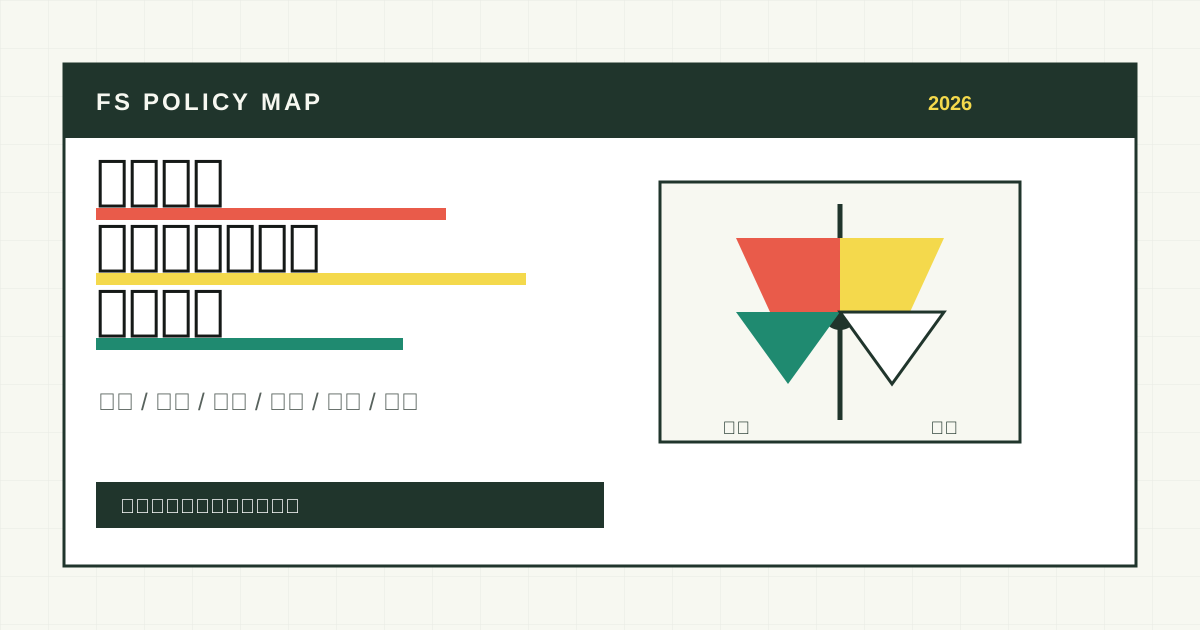
Surrogacy is not a question that can be solved by emotional voting. It involves the reproductive wishes of infertile families, the bodily boundary of the woman who carries the pregnancy, the identity of the child, underground-market control, medical regulation and social ethics.
Under the current mainland Chinese framework, medical institutions and professionals may not perform surrogacy technology, and the trade of gametes, zygotes and embryos is prohibited. Yet underground surrogacy, cross-border arrangements, contract disputes and child-identity issues have not disappeared.
Policy · Ethics · Governance
Ethics: reproductive desire and bodily boundary
A person who cannot carry a pregnancy may experience real suffering. A woman who carries for another person also faces physical, emotional and social risk. Ethical governance must refuse both extremes: romanticizing surrogacy as simple empowerment and reducing every intended parent to moral failure.
The core question is how to avoid coercion, exploitation and commodification while still acknowledging a small group of families with severe medical need.
Policy · Ethics · Governance
Law: prohibition is clear, civil consequences can be complex
The administrative rule is relatively clear for medical institutions and professionals. The harder problems appear after the fact: contract validity, parentage, child registration, custody, payment disputes, medical harm and privacy.
A system that only says no still needs rules for children already born and for adults harmed by unlawful chains.
Policy · Ethics · Governance
Demography and public health
Surrogacy cannot solve low fertility. It can only respond to a narrow group of medical or family circumstances. Treating it as a population-policy tool would be dangerous.
Public-health risk is concrete: unlicensed egg retrieval, anesthesia, embryo handling, infection control, pregnancy management and birth records can all become unsafe in an underground chain.
Policy · Ethics · Governance
Social acceptance and economic incentives
If social consensus is weak, policy should move slowly. If a market opens without strong regulation, capital will package pregnancy as a product and the weakest party may absorb the bodily risk.
At the same time, prohibition has not eliminated consumption. Some demand moves underground or abroad, creating legal and medical opacity.
Policy · Ethics · Governance
FS view: cautious, narrow and traceable
A responsible discussion should not begin with full commercialization. It should ask whether a narrow, medically necessary, reviewed, non-commercial or tightly compensated, fully traceable exception could protect people better than the underground status quo.
Any such model would need eligibility review, independent counseling, surrogate health insurance, informed consent, exit mechanism, medical record traceability, child identity rules and strict penalties for brokers and coercion.
FAQ
Is surrogacy legal in mainland China?
Medical institutions and professionals are prohibited from performing surrogacy technology, and gamete, zygote and embryo trading is prohibited.
Would legalization solve low fertility?
No. Surrogacy can only address a narrow set of circumstances and should not be treated as a population tool.
Why discuss limited reform?
Because underground demand creates harm; any discussion must be narrow, cautious and child- and woman-protective.
Sources
Review your pathway before you commit
If your case involves IVF, donor materials, surrogacy, documents or cross-border return planning, organize the medical and legal chain before comparing packages.
Request a pathway reviewThis article is for reproductive-health, legal and pathway education only. It is not medical diagnosis, legal advice or a success guarantee. Individual decisions require physician and legal review.